
Aug 18: E-Stories
InUkraine CombatSitRep BehindLines Russia-China InEurope InOtherNews

Catching up…
For a general view of news from various geopolitical threatres, Scott’s EA Worldview is always superb.
Let’s get going…
Stories we’re following…Russia has launched four Iskander-M ballistic missiles and 140 Shahed-type attack UAVs and various decoy drones against Ukraine since the evening of 17 August. Eighty-eight drones were destroyed, but there were also strikes, as reported by Ukraine’s Air Force on Telegram.
"As of 09:00, air defence either shot down or jammed 88 enemy Shahed-type UAVs and various types of decoy drones in Ukraine’s north, south, east and centre.
Enemy missiles and attack UAVs hit 25 locations in Donetsk, Kharkiv, Sumy, Dnipropetrovsk, Odesa and Kyiv oblasts."
Russian forces have attacked Zaporizhzhia on the morning of 18 August, injuring 17 people, as reported by Ukraine's Air Force; Ivan Fedorov, Head of Zaporizhzhia Oblast Military Administration.
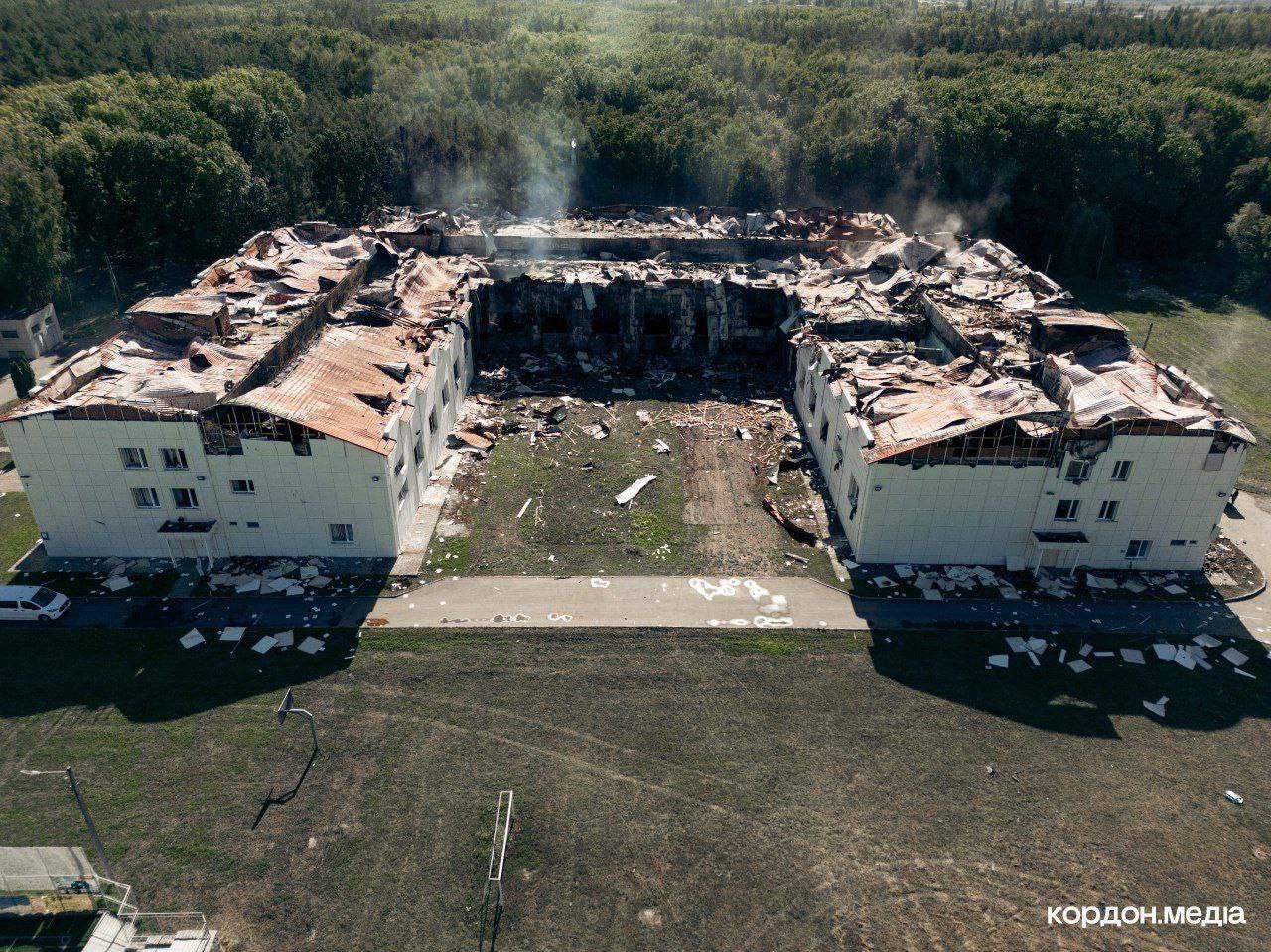
Overnight, Russia destroyed an educational facility in Sumy. This is how one of the main buildings of Sumy State University now looks from above.
Kharkiv mayor Terekhov reports that five Russian drone strikes hit a residential building, killing 7 people, including a child, and wounding 20 others (6 children).
"An entire family - our neighbors from the sixth floor - was killed..." Oksana from Kharkiv. Russia killed her neighbors: a father, a mother, their two-year-old daughter, and their 16-year-old son.
Ukraine’s FM, Andrii Sybiha, says Russia continues to kill civilians despite peace efforts ahead of the US and Ukrainian presidential summit.
“Russia is a murderous war machine that Ukraine is holding back. And it must be stopped through transatlantic unity and pressure,” Sybiha wrote on X on Monday after a Russian attack on Kharkiv, Ukraine’s second-largest city.
Sybiha also posted a photo of the smoking damage to a building, saying:
This is a residential building in Kharkiv. This night Russia killed at least four people here, including a child, and injured many more … Moscow must stop the killing in order to advance diplomacy.
Combat SituationThe 12th Azov Brigade of the National Guard successfully repelled a large-scale Russian assault on the village of Katerynivka in the Toretsk direction. Russian infantry, supported by armored vehicles, attempted to establish positions in the settlement. However, Ukrainians destroyed their equipment and neutralized advancing forces with the use of FPV drones.
Ukraine claims battlefield success in Donetsk Oblast. The General Staff said Russian forces suffered significant losses in the area, including 910 killed, 335 wounded, and 37 captured.
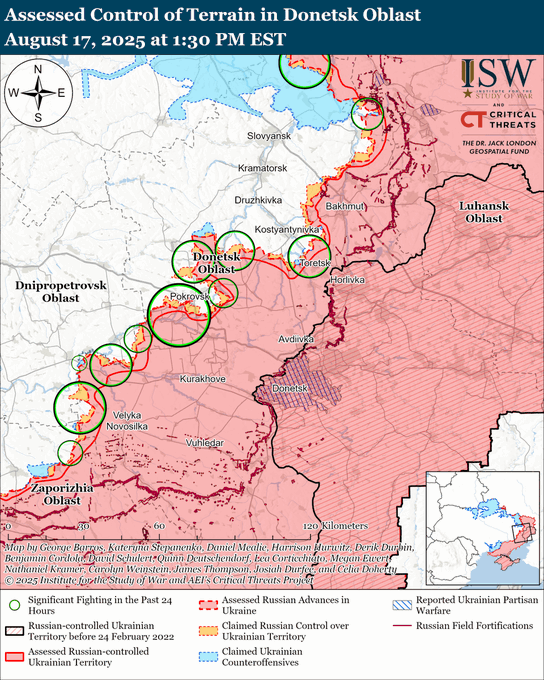
ISW: Putin's claim that Russian forces will inevitably seize all of Donetsk Oblast if the war continues is false. Russia could only rapidly seize all of Donetsk Oblast if Ukraine concedes to Putin's demand and withdraws from the remainder of the oblast.
The Russian campaign to seize all of Donetsk Oblast has been ongoing since Russia's first invasion in 2014 and remains incomplete.
Russian forces have been bogged down in campaigns to seize multiple towns and cities in Donetsk Oblast since the start of Russia's full-scale invasion in 2022, and Russian forces are still struggling to achieve the objectives of several of these campaigns today.
Seizing the remainder of Donetsk Oblast will very likely take Russian forces multiple years to complete after several difficult campaigns.
Russian forces first began efforts to retake Kupyansk, Kharkiv Oblast in October 2023 and have conducted multiple separate campaigns aimed at seizing the town in the nearly two years since. Russian forces are currently struggling to complete the encirclement or envelopment of Kupyansk from the northwest and have not yet seized the settlement despite 22 months of offensive operations.
Russian forces began a dedicated effort to seize Toretsk, Donetsk Oblast in mid-June 2024. Russian forces started this effort not far from the positions that Russian forces held prior to the start of the full-scale invasion in 2022. Russian forces seized Toretsk by August 1, 2025, taking 14 months to advance about 6.4 miles from the southeastern outskirts of Toretsk.
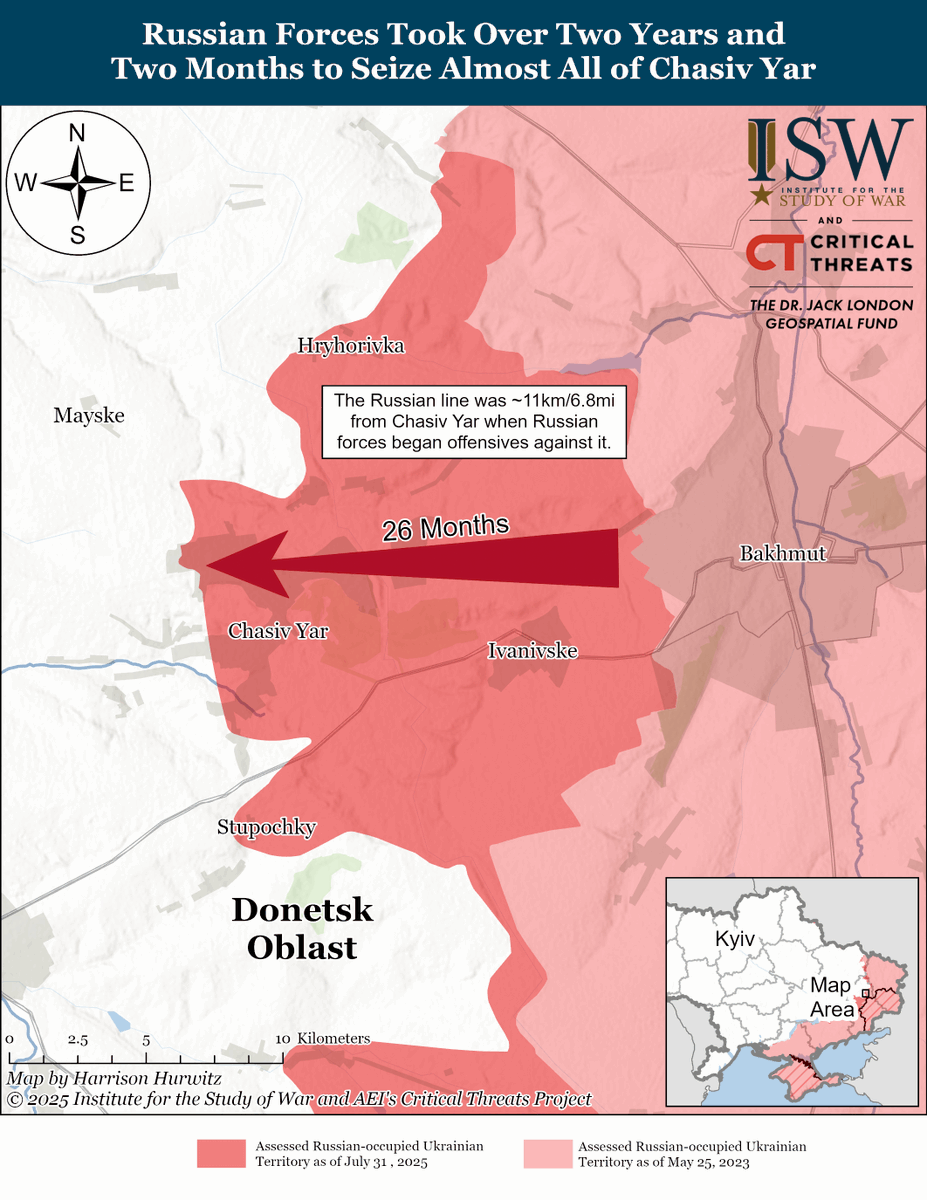
The Russian campaign for Chasiv Yar, Donetsk Oblast began in May 2023 after Russian forces seized Bakhmut (east of Chasiv Yar), and Russian forces intensified efforts to seize Chasiv Yar in April 2024. It has taken Russian forces 26 months to advance about 6.8 miles (roughly 11 kilometers) from western Bakhmut to the western edge of Chasiv Yar.
Russian forces began efforts to seize Pokrovsk, Donetsk Oblast in February 2024 after the seizure of Avdiivka and have dedicated multiple efforts to seizing Pokrovsk through frontal assaults, envelopment, or encirclement – all of which have thus far been unsuccessful after more than 18 months.
Ukraine continues to degrade Russian capabilities:
ICYMI: Ukrainian drones hit key rail hub in Russia's Voronezh Oblast, HUR says. The strike disrupted train traffic through the Lisky station, halting the supply of ammunition and troops to aid Russian forces fighting on Ukrainian territory, according to the source. The plant makes TNT, RDX, propellants & shell casings.
Damage confirmation. A major blast hit the “Elastic” gunpowder plant in Ryazan region on Aug 15. Cause: mishandling explosives.
Destroyed: 4 buildings, incl. powder storage.
Lost: ~300 tons of artillery powder & ~600 shells (152mm).
Casualties: 14 dead, 19 missing, 149 injured (40 hospitalized).
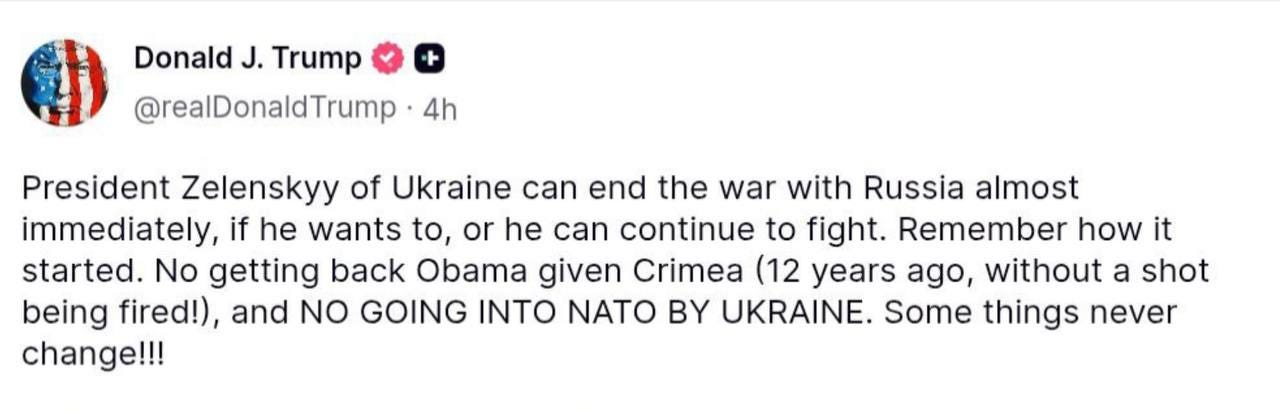
Behind the LinesThe opening salvos for Monday’s meeting with president Zelenskyy from the White House. Trump took to rage tweeting during the night against Ukraine, which means he was not too happy that the European cavalry was accompanying Zelenskyy. As I posted yesterday, all the pressure is on Zelenskyy, while the Trump administration doesn’t plan to put any pressure on the Kremlin.
ICYMI: Special US envoy Steve Witkoff said on Sunday that Putin agreed to allow the US and European allies to offer Ukraine a security guarantee resembling Nato’s collective defence mandate (article 5: an attack on one member is an attack on all) as part of an eventual deal to end the war. (Mo: I don’t believe this at all.)
NB: Witkoff and U.S. Secretary of State Marco Rubio addressed the outcomes stemming from the Trump-Putin meeting, providing differing accounts of the progress made towards providing Kyiv with security guarantees.
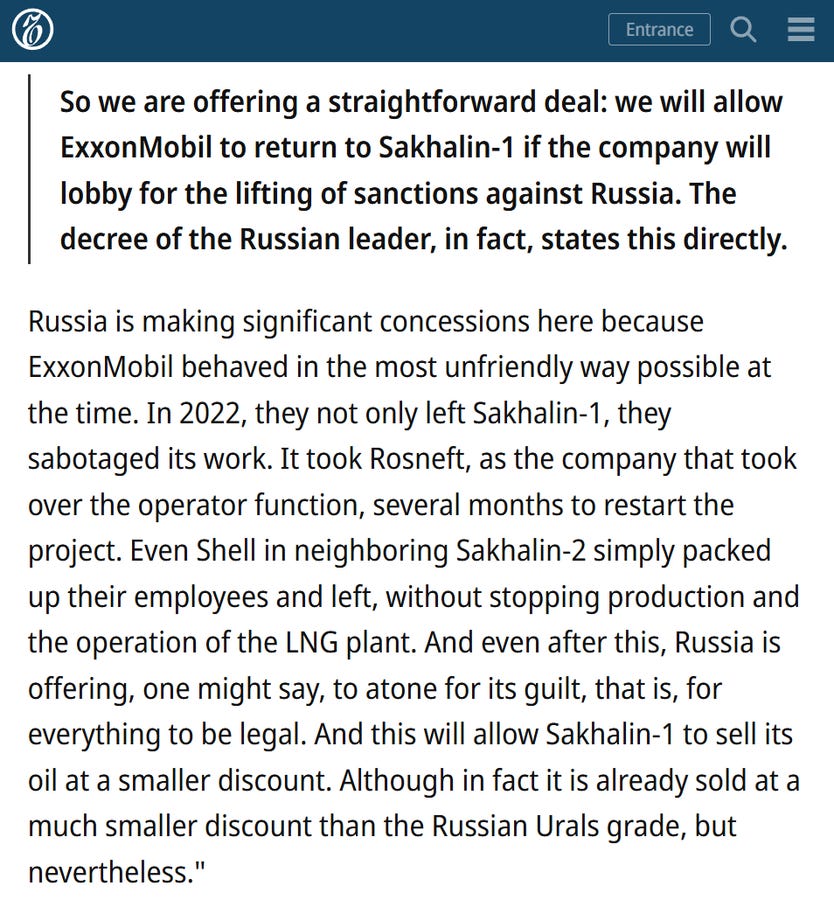
Madi Kapparov: Before the Alaska summit, Putin signed a decree paving the way for ExxonMobil's return to Russia. The Kremlin is creating financial incentives for the US to lift sanctions.
The Russians wouldn’t be doing this if they could continue funding the war. The Coalition of the Willing should move quickly to crush this sector of the Russian income flow because it constitutes 70% of their GDP.
ICYMI: Zelenskyy has released a series of statements on X after his meeting with European leaders ahead of Monday’s peace talks with Trump in DC. In his statements, Zelenskyy said:
“Ukraine’s constitution makes it impossible to give up or trade land. Since the territorial issue is so important, it should be discussed only by the leaders of Ukraine and Russia at the trilateral—Ukraine, the U.S., Russia. So far, Russia gives no sign this will happen, and if Russia refuses, new sanctions must follow.”
ICYMI: n Saturday, European leaders adopted a statement saying:
“No limitations should be placed on Ukraine’s armed forces or on its cooperation with third countries. Russia cannot have a veto against Ukraine‘s pathway to EU and Nato.
It will be up to Ukraine to make decisions on its territory. International borders must not be changed by force.”
Russian propagandists at RT are sending an arrogant message to the West ahead of the Washington meet. Yes, that’s an American flag on an M113 APC next to the Russian flag: we’re going to take Ukraine, and the US is with us. This is who they are.
Russian telegram channels and their proxies in diverse countries were giddy on Monday morning. The main narrative is that Zelenskyy is ready to cede territory to Russia—’surrender’ it.
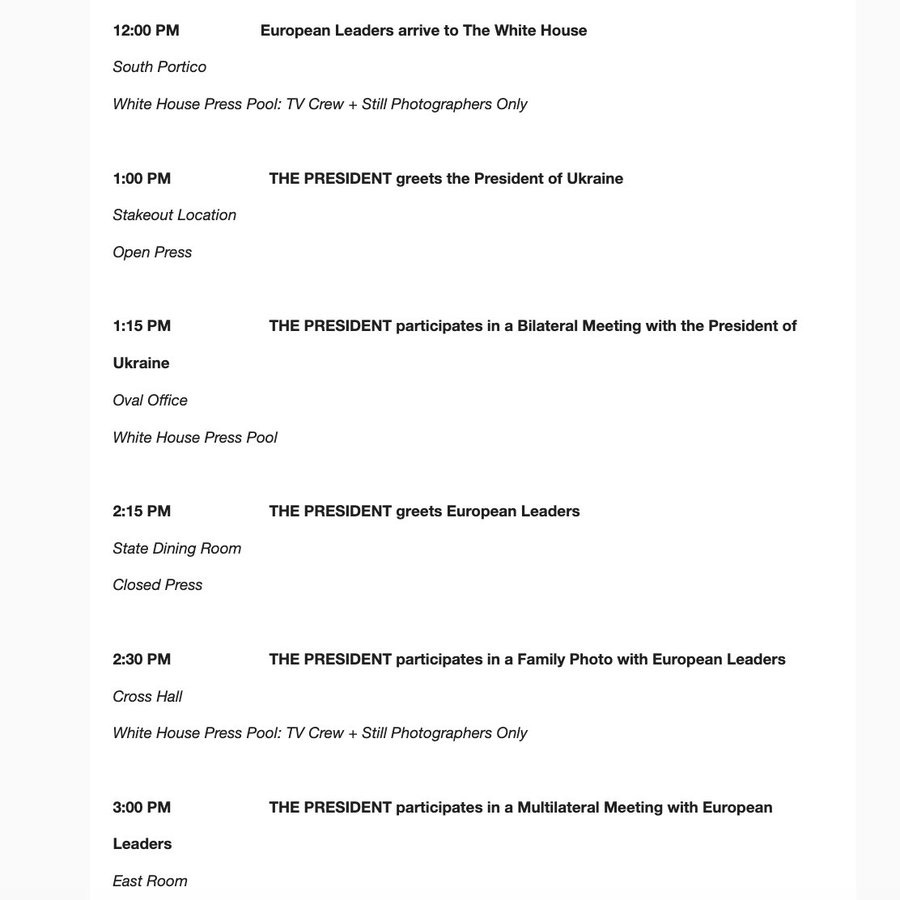
Monday’s schedule of meetings at the White House
Donald Trump is to hold a bilateral meeting with Ukrainian president Volodymyr Zelenskyy at 1.15pm (5.15pm GMT) on Monday at the White House, and a meeting with the Ukrainian president and the European leaders at 3:00 PM local time.
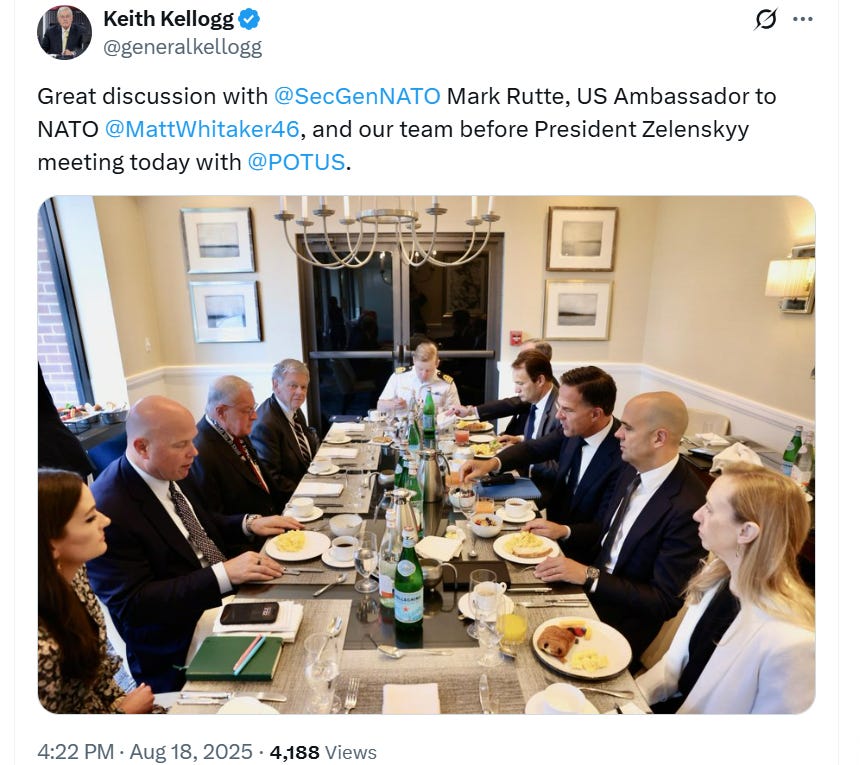
And the meetings have begun…
Meanwhile in Russia & China…Russia to abandon grain shipbuilding and order vessels from China: The three largest exporters of Russian grain need more than 60 bulk carriers to renew their fleets, but the cost of building them in Russia is four times higher than in China. For this reason, Rosagroleasing and the United Shipbuilding Corporation (USC) have agreed to place orders for the first ten vessels at Chinese shipyards. This follows from materials for a meeting held at the Ministry of Agriculture on the "old" fleet, which Kommersant has reviewed. In addition, as noted by USC, the construction period for the lead ships in Russia will be at least two and a half years.
Kyiv Insider: Russia’s gasoline crisis continued to spread across the country’s regions over the weekend. Shortages, official rationing, and sudden price spikes are being reported from the Far East to Buryatia and occupied Crimea, undercutting Moscow’s narrative of stability.
Drivers in Vladivostok are struggling to find 92nd and 95th gasoline at most stations, though diesel remains available, RIA VladNews reports.
In Ussuriysk, motorists have reported persistent shortages of AI-95, alongside price increases of 5–10 rubles per liter compared to earlier months.
In Krasnokamensk, not a single gas station has 95th gasoline. They say that supplies have run out. At the gas station of the ‘Soyuz i K’ chain, there are signs that AI-95 is available only for organizations.
The Crimean Ministry of Fuel and Energy admitted to “temporary difficulties” in supplying the peninsula through the Kerch Strait.
In Buryatia’s Severobaikalsky District, fuel prices have spiked sharply. Residents of Novy Uoyan reported a jump of nearly 10 rubles per liter in just three days—from 60.70 to 69.90.
Russian taxi companies are preparing to sell off foreign cars en masse from March 2026, company representatives told Izvestia at the International Eurasian Taxi Forum (MEFT). The reason for this is a new law requiring only domestically assembled cars to be used for transporting citizens. In particular, the innovation prohibits carriers from purchasing foreign cars and re-registering foreign cars already in use in the transport register.
A famous Italian YouTuber, Dave Legenda, meets young Russian tourists in Abkhazia who explain that in winter everything is closed, salaries are 300€, electricity only for 2 hours a day! Being in Russia's sphere of influence means permanent poverty. Abkhazia is a Russia-puppet regime, to which the Russian government will apply punitive measures in order to keep it under control.
Testing the publics’ reaction in Russia to cutting pensions:
Russian citizens may not have done enough for the state to receive a pension from it, believes State Duma deputy and Olympic figure skating champion Irina Rodnina.
According to 75-year-old Rodnina, who previously stated that her pension does not exceed 30 thousand rubles, like that of a “normal Russian person,” a pension is not a salary, but rather an old-age benefit.
“In some countries there are no state pensions at all,” Rodnina said in an interview with Sport24.
"We are constantly asking the question of what the state should do: "Is the country doing enough to provide good pensions?" And is the population doing enough for its country to be comfortable creating such conditions? This is a mutual process, a two-way road. You can't always count on someone, it's time to become independent," the deputy, a member of the Supreme Council of United Russia, urged.
In a new effort to bypass Western sanctions, Russia asked Ethiopian Airlines to provide passenger jets under a “wet lease” arrangement that would include aircraft, crews, maintenance, and insurance. The request was made during a high-level visit to Addis Ababa by Russian Trade Commissioner Yaroslav Tarasyuk, who met with officials from Ethiopia’s Civil Aviation Authority to discuss expanding bilateral cooperation in aviation.
However, Ethiopian Airlines swiftly poured cold water on the plan. In a direct denial issued to the press, the airline rejected any involvement or intent to pursue such an agreement. That leaves Russia’s scheme not only grounded, but publicly rebuffed by a country it likely hoped would quietly cooperate.
The stakes were high. Russian carriers, starved of parts and aircraft, are operating at unsustainable capacity with some routes reaching 96% occupancy. With domestic aircraft like the Sukhoi Superjet and MC-21 failing to scale or perform, the Kremlin is left scavenging for lifelines in what it calls “friendly” nations.
On the night of August 18, Russian military personnel attacked the Odessa region of Ukraine with drones. The attack hit a "fuel and energy infrastructure facility," said the head of the regional military administration, Oleg Kiper. He specified that a "massive fire" broke out as a result, and a special Ukrzaliznytsia train had to be called in to extinguish it.
According to local media, drones hit the terminal of the Azerbaijani state oil and gas company Socar. This information is also confirmed by z-publics. "They hit the oil depot of the Azerbaijani company SOCAR in Usatove, Odessa region, again))) so that [the president of the republic Ilham] Aliyev doesn't relax either)", - says a post on the Telegram channel Troika (spelling and punctuation preserved).
The Azerbaijani publication Minval writes that as a result of direct drone hits, all 17 tanks, a pumping station, operator and technical rooms of the terminal were destroyed. The storage facility contained more than 16 thousand cubic meters of fuel. The extent of the damage is being clarified, urgent restoration work is being carried out.
Russia Expands Terror Operations In the EU, Targeting Oil Supplies. Romania’s state of emergency has cast a harsh spotlight on Europe’s energy vulnerabilities, with suspicions of Russian sabotage tainting Azerbaijani crude oil via the Baku–Tbilisi–Ceyhan pipeline. The contamination, detected at Ceyhan, Turkey, with organic chlorides, has idled the Petrobrazi refinery, signaling a bold escalation in Russia’s hybrid warfare.
RFE/RL: Manalit a Russian-owned manufacturer based in Belarus, has become a critical supplier of high-reliability electronic components for missiles, radars, and aircraft used by Russia in its war against Ukraine. Manalit specializes in multilayer ceramic capacitors of exceptional durability, certified for use in military and space applications.
Belarus was not subject to the same restrictions until 2022. For nearly eight years, Manalit exploited this gap, importing equipment and materials from Europe and the United States, then shipping finished components to Russia to replace banned Western parts.
Within the first two years of Russia's full-scale aggression against Ukraine, which began in February 2022, Manalit's annual profits increased nearly sixfold, driven almost entirely by military exports to Russia.
Even today, despite EU and US sanctions, Manalit is allowed to purchase Slovenian KEKO production lines, equip them with Japanese Pro-face control panels (owned by France's Schneider Electric), and continue sourcing American precious-metal powders for capacitor production.
According to a specialist from the Ukrainian Defense Ministry's Main Intelligence Directorate (HUR), Manalit-made K10-84 capacitors have been found in Russia's Iskander ballistic missiles, Kalibr cruise missiles, Kh-101 air-launched cruise missiles, S-200 and S-300 air-defense missiles, as well as Zoopark counter-battery radar systems.
Reuters: Taiwan is an internal matter for China, Beijing's foreign ministry said on Monday, in response to U.S. President Donald Trump saying Chinese President Xi Jinping told him he will not invade the island while Trump is in office.
Trump made the comments in an interview with Fox News, ahead of talks in Alaska with Russian President Vladimir Putin over Moscow's war with Ukraine.
"The Taiwan issue is purely an internal affair of China, and how to resolve the Taiwan issue is a matter for the Chinese people," she said.
"We will do our utmost to strive for the prospect of peaceful reunification. But we will never allow anyone or any force to separate Taiwan from China in any way."
Jamestown Eurasia Monitor: Inroads in Algeria: The Promise and Perils of Beijing’s Localization Strategy
The One Belt One Road initiative is evolving, with Chinese enterprises beginning to localize. In Algeria, this has led to increased exposure to the corruption and mismanagement that continue to plague the country’s economy.
This is leading to tensions with Beijing’s pragmatic commitment to non-interference in other countries’ “internal affairs.” As a result of its localization strategy, Algeria’s “internal affairs” are increasingly the PRC’s problem too.
The shift is especially evident in the digital domain. An agreement with Huawei to build Algeria’s first national-level data center would give Huawei, and by extension Beijing, a key role in the technological infrastructure underpinning Algerian public services. As Huawei shapes Algeria’s digital governance, the PRC gains not just economic access but increased influence over the state’s administrative and accountability mechanisms.
RFL/RE—Serbia: Leaked Files Reveal Serbia's Secret Expansion Of Chinese-Made Surveillance
Leaked documents show a Serbian IT company that has won Interior Ministry tenders buying new software and services from the Chinese tech giant Huawei.
One purchase order from March 2024 shows plans to expand Serbia's eLTE system, the private citywide hotspot that links the surveillance equipment and software that forms Huawei's Safe City project and allows it to operate.
Experts who reviewed the files for RFE/RL said items on the purchase order could support up to 3,500 additional cameras.
The software and services are also provided by Huawei at a substantial discount.
POLITICO: Serbian protests turned violent last week, with even President Aleksandar Vučić acknowledging that a long-running standoff with his opponents has entered “the phase of beatings,” in a TV interview Friday night.
Tense protests raged Friday evening, as tear gas billowed into the sky and heavily armed riot police deployed in Belgrade, Novi Sad, Niš and other locations across the country.
The most explosive skirmishes came Thursday night, when demonstrators directed “he is finished” chants at Vučić in Novi Sad as they smashed windows of the ruling party’s offices and hurled furniture into the street — a dramatic escalation in a nine-month protest movement that has gripped the country.
As tensions heighten, groups of pro-government football fans have appeared at protest sites and clashed with demonstrators — a pattern that opposition figures say is intended to provoke confrontations.
Mitrović was attacked Thursday night, taking a blow to the head as he tried to film a ruckus outside the ruling Serbian Progressive Party’s Belgrade offices — guarded at the time by masked men.
“After a masked person came over and told me to delete the recording, I refused and told them I was a parliamentarian, which is when he called for backup and a group of them started hitting me from all sides,” Mitrović explained.
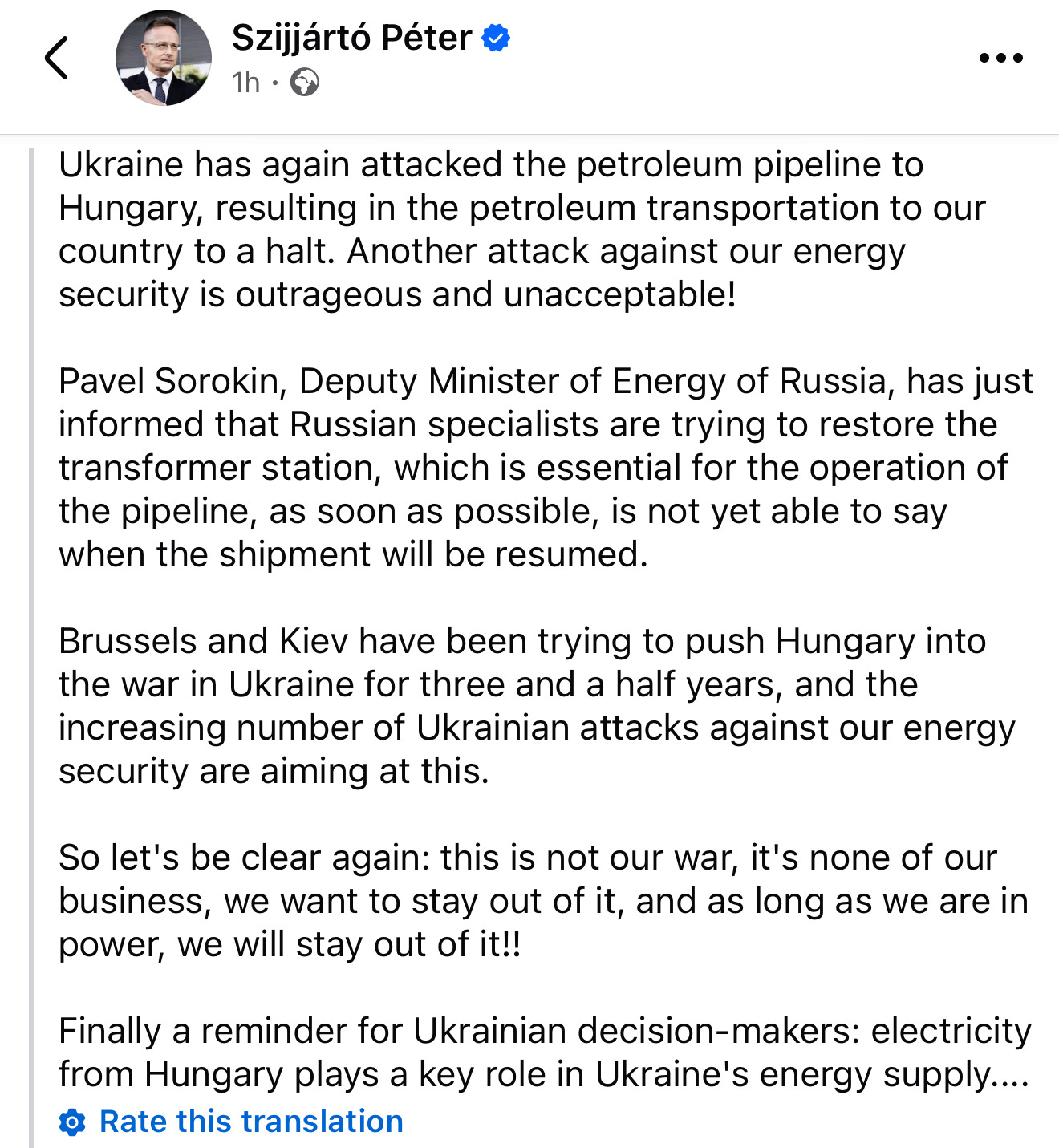
Szabolcs Panyi: As EU leaders join Zelensky at the White House, Viktor Orbán’s foreign minister threatens to cut electricity to Ukraine over an alleged attack on Russia’s Druzhba pipeline. (Hungary's MOL oil company still buys Russian oil, re-sells it at a profit, and resists phasing it out.)
OC Media: Georgia’s Anti-Corruption Bureau has launched inspections against six prominent civil society organisations under the Foreign Agents Registration Act (FARA), warning that failure to register under the law is a criminal offence.
At a joint press briefing on Friday, the groups said they had received official letters from the bureau on 11 August, describing it as a threat of criminal prosecution.
Those targeted were the Civil Society Foundation, the women’s rights group Sapari, Transparency International Georgia, the Social Justice Centre, the Media Development Foundation, and the International Society for Fair Elections and Democracy (ISFED).
The move is the first of its kind since FARA was adopted earlier this year, indicating that unlike the previous foreign agent law, the government intends to enforce the law to target critics.
In Europe…POLITICO: Friedrich Merz wants to turn Germany into Europe’s leading military power. But China still holds the reins thanks to its control of critical minerals needed by Europe's defense industry.
"If China-sourced materials suddenly fall away, that could stop our defense industrial plans in their tracks," warned Jakob Kullik, a researcher at Chemnitz University of Technology and an expert on rare earth policy.
The German chancellor’s plan to make his country’s armed forces "the strongest conventional army in Europe" comes with an unprecedented price tag. A good portion of that money is already in motion. Orders for military vehicles are running into four digits, missile production is ramping up and demand for ammunition is rising fast. Defense firms are racing to retool factories and resurrect long-idle production lines — with the hope of reviving an industrial base that faded after the Cold War.
According to the Federation of German Industries, or BDI, the country’s largest industrial lobby group, rare earth elements like neodymium and dysprosium, along with tungsten, graphite, titanium and high-purity magnesium, are the backbone of high-end military systems. They power radar arrays, electric motors, missile guidance fins, thermal sights and drone propulsion — the guts of modern warfare.
Most of them come from China.
The BDI warns the EU imports 95 percent of all its strategic raw materials — and relies on non-EU countries for 90 percent of them. Germany’s own domestic processing is nearly nonexistent. China, meanwhile, controls more than 50 percent of global processing for many critical minerals — and up to 86 percent in some of the most defense-relevant ones, including gallium and germanium. [continue reading]
Ukrainska Pravda: German Foreign Minister Johann Wadephul has stated that Germany will not deploy troops to Ukraine as part of a peacekeeping mission if the war ends, as reported by N-TV.
Wadephul said that Germany should play an "important role" in any peacekeeping mission. He noted that Ukraine needs security guarantees but ruled out deploying German forces to Ukraine.
"The Bundeswehr has already stationed a brigade in Lithuania. Deploying additional German soldiers in Ukraine would likely be too much of a burden for us," Wadephul said.
The EU is considering granting Moldova a big step forward in its bid to join the 27-member bloc ahead of parliamentary elections there in late September ― putting it ahead of Ukraine for the first time.
Under the scenario being studied by EU officials, European countries would vote to open a first “negotiating cluster” for Moldova — a key legal step on the path to membership — early next month after a meeting of EU ministers, according to three diplomats and an EU official.
Such a move would grant a powerful electoral boost to President Maia Sandu, whose party is campaigning on a pro-EU platform and faces determined efforts from Russia to sway the vote in Moscow’s favor.
“A way needs to be found to open the first cluster,” said Siegfried Muresan, a conservative EU lawmaker who chairs the EU-Moldova Association Committee in the European Parliament. “It would send a signal to Russia. It would take away the argument for the narrative of the Russians, which is to say that there is no progress on the path to EU membership.”
In other news…Reuters: Centrist senator Rodrigo Paz was leading Bolivia's presidential election late on Sunday, according to early official results, which showed the ruling Movement for Socialism (MAS) on track for its worst election defeat in a generation. Paz of the Christian Democratic Party had secured 32.18% of the vote, while Eduardo del Castillo of MAS had just 3.16%, according to initial results released by the electoral tribunal on Sunday night.
Both Russia and China have a very strong hold over Bolivia, so this will not change its industrial and foreign policy.
Peter Navarro, Donald Trump's trade and manufacturing adviser and one of the architects of his tariff policy, has lashed out at India, accusing it of providing Russia with hard currency. In pushing his trade agenda, Navarro has claimed that India is both profiting off the US and helping Russia finance its war in Ukraine.
“Here’s how the Indo-Russian oil math works,” Navarro wrote in a column in the Financial Times. “American consumers buy Indian goods. India uses those dollars to buy discounted Russian oil. That oil is refined and resold around the world by Indian traders in league with silent Russian partners [a reference, presumably, to the Russian shareholders of India’s third-largest refiner, Nayara Energy, Rosneft, and United Capital Partners – The Moscow Times ] – while Russia pockets the hard currency to fund its war machine in Ukraine.”