
Dec 28: E-Stories
InUkraine CombatSitRep BehindLines Russia-China InEurope Pond&Beyond

Catching up…
For a general view of news from various geopolitical threatres, Scott’s EA Worldview is always superb.
Let’s get going…
Stories we’re following…Kyiv was attacked with over 500 drones and 40 missiles in the early morning hours on Dec 27. At the time of this writing, 27 people in the capital were injured and one woman killed. One of the missiles also hit the university dorm and luckily, no students were there at the time. The attack continued for over 8 hours.
Ukraine’s Interior Ministry reports widespread damage in Kyiv after the attack. More than 10 apartment blocks, private homes and civilian infrastructure were hit. Nearly 70 elderly residents were evacuated from a care facility in Darnytskyi district, while dangerous high rise structures are being dismantled in Dniprovskyi.
Russia launched Kinzhal hypersonic missiles, ballistic missiles and Kalibr cruise missiles simultaneously. Energy infrastructure was targeted, including CHPP-4, CHPP-5, CHPP-6 and the hydroelectric plant. Power and water outages are reported across multiple districts.
As reported by the Kyiv City Military administration, the consequences of the Russian attack have been recorded in six districts: Darnytskyi, Dniprovskyi, Solomianskyi, Obolonskyi, Holosiivskyi, and Desnianskyi.
Almost a third of the capital is without heating, and a portion of Kyiv’s left bank remains without electricity, according to Kyiv Mayor Vitali Klitschko.
“Aid hubs for the injured will be deployed after the danger has passed. A more detailed assessment of the consequences and damages will also be available after the all-clear is given”– KMVA
Two Polish airports—in Rzeszów and Lublin—temporarily suspended aircraft arrivals and departures following the massive Russian air strikes on Ukraine on the night of December 27. The Polish Air Transport Authority stated that the decision was made "due to the need to ensure the freedom of operation of military aircraft."
On December 26, four men were killed in Kharkiv and in the village of Podoly in the Kurylivska community; seven people were injured in the regional center, including a nine-month-old girl, as reported by Kharkiv Oblast’s head Oleh Sinehubov.
On the night of December 27, Russian forces carried out an attack on the city of Sloviansk with three KAB bombs. At least one woman was injured.
Over the past 24 hours, 22 villages have been attacked by Russian drones and missiles.
Intrep360 reporting that on 23 Dec, Kristina Solovyova – just four-years-old – didn’t live to see another Christmas. 676 kids have been murdered by the Russian forces in Ukraine thus far. Kristina was killed when Russian forces attacked her home city of Zhytomyr. The town is a key railway hub linking Kyiv with Warsaw.
A Russian Shahed drone struck a bus stop in Bila Tserkva. Another deliberate attack on civilians. Russia continues to wage war not on the battlefield, but against ordinary people going about their daily lives.
The Financial Times: “Russia is constantly looking for reasons not to agree” to a peace deal, Zelenskyy told reporters on Friday. But he said it was crucial for Ukraine to keep pressing ahead with its partners on a plan.
“The answer is simple: if Ukraine demonstrates its position, it is constructive. If Russia does not agree, it means the pressure is insufficient,” he said, adding that he would talk with Trump about further pressing Russia.
Combat SituationUkraine’s General Staff confirmed overnight strikes on Russian targets in occupied Donetsk region. Concentrations of personnel from Russia’s 14th Spetsnaz Brigade were hit in Berdianske, along with a logistics depot of the 228th Motor Rifle Regiment near Starobesheve. A fuel depot was also confirmed destroyed near occupied Volnovakha.
In Dronivka, Donetsk region, the situation is difficult but fully under the control of the units of the 81st Separate Slobozhanska Airborne Brigade of the Air Assault Forces of the Armed Forces of Ukraine. Such data is provided by the Eastern Operational Group of Forces.
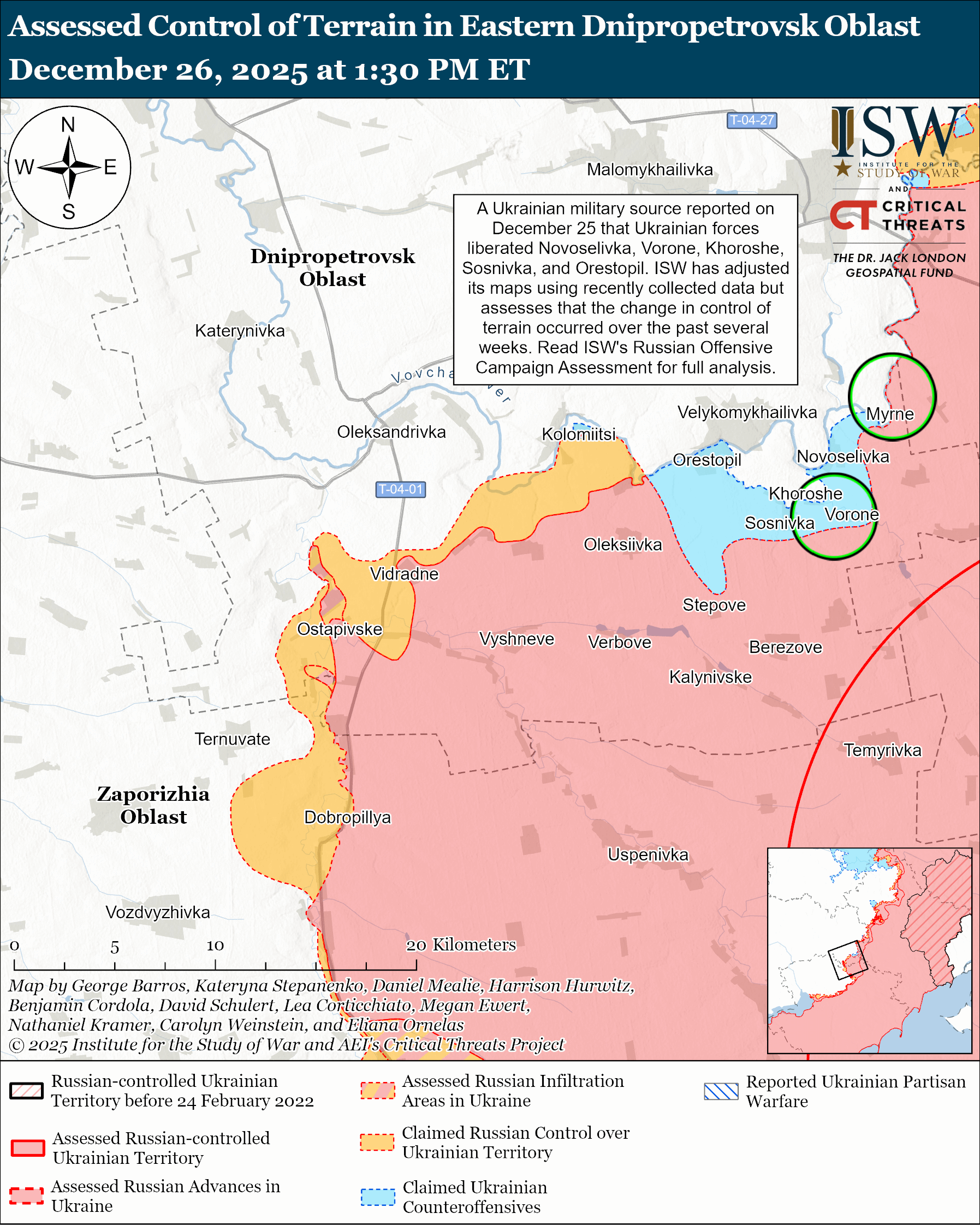
ISW: Ukrainian forces continue to make tactical gains in Kupyansk, and Russian milbloggers are increasingly acknowledging Ukrainian successes.
The situation in the Oleksandrivka and Hulyaipole directions continues to show how Russian forces are able to make gains when they concentrate forces on a specific sector, but often at the expense of other areas.
Ukrainian forces recently advanced near Kupyansk and Oleksandrivka, and in the Kostyantynivka-Druzhkivka tactical area.
Russian forces recently advanced in the Kostyantynivka-Druzhkivka tactical area, western Zaporizhia Oblast, and near Siversk and Hulyaipole.
NV of Ukraine: Russia fakes ISW report to claim only 30% of France’s nukes are functional
The center emphasized that ISW has published no such assessment. In fact, the institute does not conduct technical analyses or audits of NATO countries’ nuclear arsenals.
“The fake is built on a typical Kremlin pattern. A fabricated message, attributed to a respected Western institution, is used to discredit France, its defense capabilities, and President Emmanuel Macron — and to create an illusion of ‘NATO weakness,’” the center explained.
The CCD also noted that Russian propaganda routinely relies on disinformation and artificial intelligence. Previously, it documented widespread AI-generated fake reports about Kupyansk.
As CCD head Andrii Kovalenko said, Russian propagandists had been tasked with spreading false claims that Ukrainian President Volodymyr Zelenskyy was not in the city and that Kupyansk was under Russian control.
In addition, fake videos featuring AI-generated “Ukrainian soldiers” have resurfaced on social media platforms, including TikTok. These clips push Kremlin narratives about “collapsed defenses,” “chaos in the ranks,” and “an indifferent command” — all part of a broader Russian information operation.
Denis Kapustin, “WhiteRex”, founder and commander of the Russian Volunteer Corps, was killed overnight on the Zaporizhzhia front. According to the unit, he died while carrying out a combat mission, preliminary reports point to an FPV drone strike.
Rusland Trad reports that during Kapustin’s years in Germany, he provided combat training to members of various far-right organizations, including Switzerland's PNOS and the banned British group National Action.
Kapustin moved to Ukraine around 2018 and founded the Russian Volunteer Corps in August 2022, a paramilitary formation of Russian citizens fighting against Russia in the ongoing war. The RVC conducted several cross-border raids into Russian territory, including attacks on Bryansk Oblast in 2023 and Belgorod Oblast in May 2023.
In Russia, he was sentenced in absentia to life imprisonment for his activities, including organizing attacks on Russian infrastructure and a foiled assassination attempt.
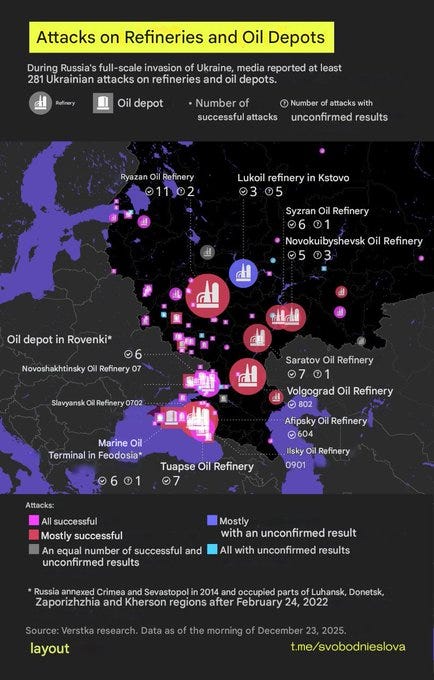
Ukrainian forces struck Russian oil refineries and fuel depots at least 142 times in 2025, up 51% from 2024, Russian independent outlet Vyorstka reported. Since the war began, Ukraine hit oil infrastructure 281 times with 82% success rate.
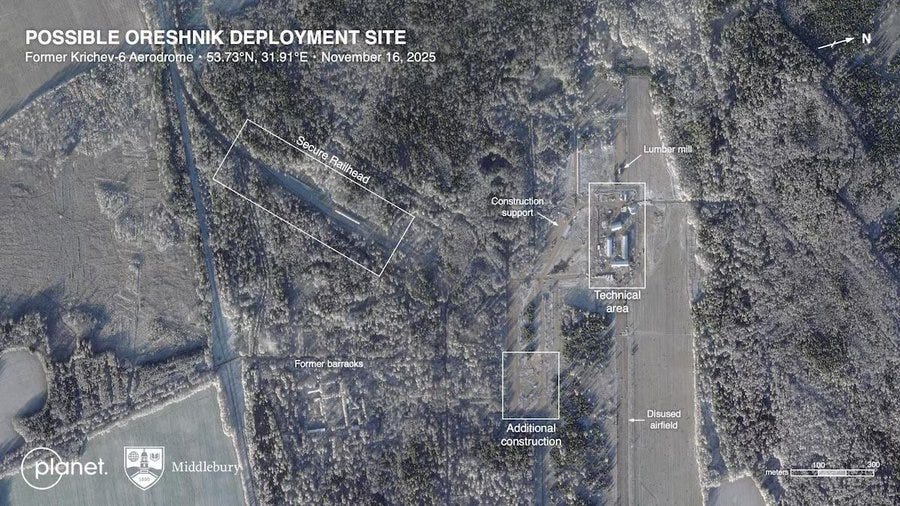
Reuters: Russia is likely stationing new nuclear capable Oreshnik hypersonic missiles at a former airbase near Krichev in eastern Belarus. Satellite imagery suggests launch infrastructure is already in place. (Mo: So much for the U.S. lifting sanctions against Belarus.)
The move would extend Russia’s strike reach across Europe and signals deeper reliance on nuclear threats. The Insider reports that the missile complex "Oreshnik," sent to Belarus, is deployed at the former military airfield "Krichev-6" as per information from American researchers, Jeffrey Lewis and Michael Duitsman. On December 23, the Russian state news agency TASS published, and then retracted, a report that stated that Belarus “will, if necessary, independently determine the targets of Oreshnik.”
Hromdaske: Budanov said that Russia plans on recruiting 409,000 contract soldiers in 2026. Russia met its target for 2025—403,000—in early December and will be exceed it.
Russia continues systematically recruiting foreign fighters for war, Ukraine says. Russia is continuing to systematically recruit foreign nationals for its war against Ukraine, said Oleh Ivashchenko, head of Ukraine's Foreign Intelligence Service, on Dec. 26.
Behind the LinesPolitico: Zelenskyy “doesn’t have anything until I approve it”, Trump told Politico on Friday. “So we’ll see what he’s got.”
Trump believe[s] he could have a productive meeting this weekend. “I think it’s going to go good with him. I think it’s going to go good with [Vladimir] Putin,” Trump said, adding that he expects to speak with the Russian leader “soon, as much as I want.”
Kateryna Lisunova: Zelenskyy—”Coalition of the Willing” will only send its contingent after a ceasefire or the end of the war. (26 Dec 2025) European leaders won’t be present at Mar-a-Lago this weekend, but Zelenskyy reiterated that he is meeting with them virtually prior to the Mar-a-Lago meeting.
Zelenskyy has also described territorial issues and the Zaporizhzhia Nuclear Power Plant (ZNPP) as "red lines" for Kyiv in the peace talks. "Of course, there are 'red lines' for Ukraine... These include both the territories and the ZNPP. You know my position – we will not legally recognize anything under any circumstances," Zelenskyy said (quoted by RBC-Ukraine).
Q: Which countries are ready to send their contingents to Ukraine - France, Britain, Germany, Austria, or others?
Z: "Regarding the protection contingent in the sky, at sea, and on land, as I mentioned, we have agreements with partners. Some small details remain.
In principle, we have the coalition framework, but signing it and deploying any personnel or resources will only happen after a ceasefire. The "Coalition of the Willing", will only begin operating at the moment of ceasefire, - either a ceasefire or the end of the war.
All details about which countries and what they're ready for, are there (in the agreement). As I've already said, 30 countries are in our Coalition of the Willing. Details will come later."
On the possibility of elections and a referendum in Ukraine:
"First of all, I want to say that the push for elections came from the American side. There were signals, as I've mentioned many times, that we need legislative mechanisms and most importantly, security to hold elections.
If we're talking about a referendum, security is also needed. Legislative initiatives exist and can be modified regarding war, timing, etc. This is a secondary issue, though important. But security comes first.
Our partners have enough power to force Russia or negotiate with Russians to provide adequate security and infrastructure for presidential elections or a referendum.
Regarding referendums, the 20-point plan addresses this issue. For sensitive questions that no individual, not even Ukraine's President, can answer alone - there are matters only the Ukrainian people can decide. Parliament certainly has tools too. But I believe it's right that Ukraine's fate is decided by its people. And that's how it should be."
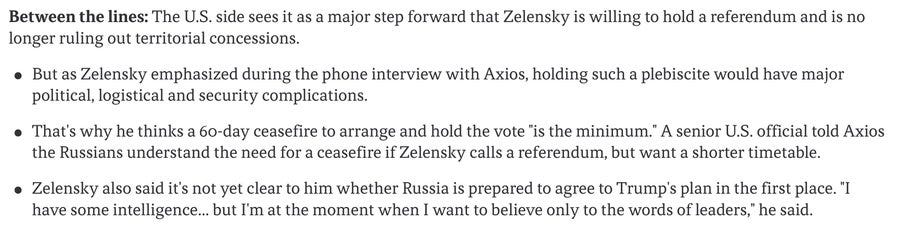
President Zelensky is to meet with Trump in Washington this weekend. Axios reported that Zelensky is ready to put a peace plan to a national referendum if Russia agrees to a 60 day ceasefire.
He notes Trump’s plan still demands painful territorial concessions in the east, and any deal without a strong position would require approval from the Ukrainian people.
ISW: Ryabkov and other Kremlin officials are trying to exploit the lack of clarity about the outcome of the US-Russian Alaska Summit in August 2025 to claim that the summit achieved a joint US-Russian understanding and agreement to end the war in Ukraine — contrary to US accounts of the summit.
Ryabkov demanded that any peace agreement must completely address the ultimatums that Russia issued to the West in late 2021, demonstrating how Russia is demanding a radical restructuring of the security architecture in all of Europe.
The Kyiv Institute of Sociology reports a majority of Ukrainians are opposed to holding national elections during the war: only 9% of Ukrainians believe that elections should be held “right now, before a ceasefire,” while in September this figure stood at 11%.
Michael Weiss: Zelensky has turned the painful question of territorial concessions into a joint challenge for Trump and Putin, and he has deferred responsibility for whatever happens to the Ukrainian people, the better to keep his legacy from being tarnished by a forfeiture of national sovereignty.
Trump would have to guarantee the security of holding a national referendum (and it's unclear whether Ukrainians in the occupied territories would get a vote, or how they might vote under foreign coercion).
Putin would have to accept a 60-day ceasefire, twice as long as the one on offer by the U.S. and Ukraine in May, which Putin rejected.
Comparing a referendum on giving up Donetsk to Brexit is cheeky: 75% of Ukrainians rejected this proposal as of Dec. 15, according to the Kyiv International Institute of Sociology, and so to change their minds, the U.S. would have to really incentivize them.
In short, Zelensky is calling America and Russia's bluff. And doing it with a handshake and a smile and invitation to Trump to come to Kyiv.
Ariana Gic: It does NOT matter if Russia rejects the "20 point peace plan" agreed to by Ukraine and the US. This plan is a victory for Moscow because it makes clear that with enough coercion, principally from Trump, Kyiv will agree to a whole host of unacceptable concessions.
The needle has been dramatically shifted. From Zelensky's 2024 Victory Plan to agreeing to unconditional ceasefire in March '25 after coercion from Trump, to now agreeing to make territorial concessions & a "referendum" on a demilitarized, so-called "Free Economic Zone", etc.
The message to Moscow is clear: Give it more time, push harder, more concessions will follow. Europe accepts Trump's coercion to force Ukraine's surrender under the demented illusion that it'll be spared as a result. Europe is losing without fighting.
The Wall Street Journal: Trump’s Inner Circle Sees Russia as an El Dorado for Business, but Pitfalls Abound
For Steve Witkoff and Jared Kushner, President Trump’s billionaire envoys working on a deal to end the Ukraine war, Russia is a land of vast natural resources and rich business opportunities.
Welcoming it back into the world economy will make money for American investors and stabilize Moscow’s relationships with Ukraine and Europe, according to their public comments and people familiar with their thinking.
They aren’t the first U.S. business people to view Russia as a land of bounty—nor the first to advocate for peace through profits.
But many veterans of its volatile economy are skeptical that the country will handsomely reward U.S. capital, or that many American investors will flock to Vladimir Putin’s regime as soon as Washington lifts sanctions.
“Russia is not the Emerald City or El Dorado,” said Charles Hecker, a geopolitical risk analyst who spent four decades working in the Soviet Union and Russia. “The size of the prize is smaller than some people think.”
Russia’s $2.5 trillion economy—the same size as Italy’s—suffers from weak long-term growth prospects, a shrinking population, declining reserves of oil that can be easily extracted, and a lack of growth drivers beyond energy, say economists.
What’s worse, say experienced U.S. investors in Russia, is the risk of losing your assets—and even ending up in jail—in an increasingly autocratic and nationalistic regime that lacks the rule of law, rewrites the terms of deals, seizes property and views the West with deep suspicion. (continue)
Please check the date on this…
Meanwhile in Russia & China…In 2026, Russia plans to combat “neocolonialism” and protect Russian-speaking people “wherever they may be,” said Deputy FM Sergei Ryabkov. He stated that strengthening its security “in every sense” will be a key objective of the country’s foreign policy.
“Regardless of the distances separating Russia from various countries, deepening our alliance with our neighbors and caring for and protecting Russians and Russian-speaking residents [will be at the forefront of our work]. Wherever they are, they must feel protected by the Motherland,” Ryabkov said in an interview with Rossiya-1. He expressed hope that Moscow will achieve success in all these areas by 2026.
The Russian government has extended the temporary ban on the export of motor gasoline, diesel fuel, and a number of other petroleum products until February 28, 2026. The ban on gasoline exports will apply to all exporters, including producers. Conversely, restrictions on the export of diesel, marine fuel, and gasoil do not apply to direct producers of petroleum products. The relevant decrees were signed on December 25 and 26 and will take effect on the day of their official publication.
The American company Google has notified Russian providers of its intention to withdraw its Dell R720 servers, which accelerate content delivery for users , sources told RBC. According to them, this equipment is used as part of the Google Global Cache (GGC) system for storing YouTube videos, maps, Android app and Chrome browser updates, Google search images, and more. The company stopped installing such servers in Russia after the outbreak of the war with Ukraine.
The Insider: Russian customs data for 2025 lacks information on deliveries of 180 categories of technically complex goods (primarily in the electronics and industrial sectors). Judging by the fact that importers have not ceased operations, it appears that these delivery data have simply ceased being entered into the customs database. This is an attempt by the authorities to conceal information about "gray" imports and avoid new sanctions against suppliers of critical goods, primarily for the military-industrial complex. The downside of these manipulations could be a problem for public administration and planning, as relying on Rosstat data will no longer be possible.
The Russian corporation "Rosatom" has for the first time purchased critical equipment for nuclear power plants from China - two turbogenerator units from the Chinese state corporation Dongfang Turbine, which are intended for Leningrad NPP. As reported in the intelligence, this not only demonstrates the technological degradation of Russian nuclear engineering, but also actually establishes long-term dependence on China.
The Japan Times: China orders travel agencies to slash group tours to Japan as dispute festers
The Chinese government is instructing travel agencies in the country to reduce the number of group tours to Japan as the two countries’ dispute following Prime Minister Sanae Takaichi’s remarks about Taiwan continues to fester.
One agency has been told to lower the frequency of such tours to about 60% of previous levels, while another has been urged to cancel all sales, sources said Friday.
The move is believed to be aimed at making Chinese citizens comply with Beijing’s call to avoid visiting Japan, further raising the pressure on its Asian neighbor.
One major state-owned agency was ordered to stop handling all group tours to Japan. Despite ceasing sales immediately, authorities visited an outlet to check compliance and threatened penalties if the travel agency did not follow the instructions.
According to Chinese media, 2,195 flights to Japan next month, or 40.4% of all Japan-bound flights, will be canceled.
Reuters: Profits at China’s industrial firms in November fell at their fastest pace in over a year, as weak domestic demand offset resilience in exports in another sign of a stuttering economic recovery that backs calls for additional policy stimulus.
Profits fell 13.1% year-on-year in November, accelerating from a 5.5% drop in October, according to the National Bureau of Statistics (NBS) data released on Saturday. The sharper decline came despite better-than-expected goods exports and against a backdrop of persistent factory-gate deflation, maintaining pressure on policymakers to do more to address chronically soft household consumption.
The profit numbers are consistent with a broader cooling in economic activity in the fourth quarter, mainly due to the drag from soft domestic demand, said Xu Tianchen, senior economist at the Economist Intelligence Unit.
China observers say Beijing is taking some comfort from indicators suggesting that the official 2025 growth target of around 5% is still achievable, while a U.S.-China trade truce has also helped ease tensions.
The Guardian: Kim Jong-un, has highlighted how his country and Russia had shared “blood, life and death” in the Ukraine war in a new year’s greeting to Putin.
In the message, published by the state-run KCNA news agency, Kim said 2025 was a “really meaningful year” for the bilateral alliance that was consolidated by “sharing blood, life and death in the same trench”. North Korea confirmed in April that it had deployed troops to support Russia’s military campaign against Ukraine and that its soldiers had been killed in combat. Earlier this month, Pyongyang acknowledged that it had sent troops to clear mines in Russia’s Kursk region in August 2025.
Russia has allocated an additional $9 billion in funding to Turkey for the construction of the country's first nuclear power plant, Akkuyu. This was announced by Turkish Energy Minister Alparslan Bayraktar, according to The Jerusalem Post. According to the minister, the funds will be used in 2026–2027, with plans to attract at least $4–5 billion in foreign funding in 2026. Ankara expects the nuclear power plant to be operational in 2026.
Azerbaijan has sharply criticized Russia after Moscow suspended the criminal investigation into the 2024 AZAL plane crash. FM Jeyhun Bayramov says the move raises serious questions, noting Russia admitted its air defense downed the aircraft. Baku expects Moscow to fulfill its obligations.
Foreign Intelligence Service of Ukraine: Belarus is rapidly slipping into Russia’s economic orbit, with dependence spanning key areas – from energy and trade to finance, investment, and the defense industry.
According to intelligence, Moscow is increasingly shaping the trajectory of Belarus’s economy, especially in foreign trade. A large portion of Belarus’s exports goes to Russia, with about a quarter destined for third countries via the use of Russian infrastructure. Logistical access to ports, rail routes, and tariffs is effectively coordinated from Moscow, so up to 90% of Belarus’s exports are dependent on the Russian Federation.
Financial integration is also deepening: after sanctions against the Belarusian banking sector and the disconnection of four state banks from the international payment system, Minsk has fully switched to Russian payment systems. In the currency market the situation is similar: about half of the National Bank’s currency basket is the Russian ruble, and changes in the Russian economy are immediately reflected in the Belarusian ruble’s exchange rate.
Investment dependence shows a similar dynamic: the share of Russian capital in foreign direct investment has approached 70%. Russia effectively remains the main source of external financing for Minsk. Belarus’s obligations to the Russian Federation stand at about $8 billion, and Moscow agreed to a seven-year restructuring of payments, tightening political-economic control.
A separate area has become the defense industry: since the start of the full-scale war in Ukraine, Minsk has stepped up cooperation with the Russian defense-industrial complex; at least 300 state enterprises have redirected to fulfill Russian defense contracts.
In Europe…The Guardian: Poland plans to complete a new set of anti-drone fortifications along its eastern borders within two years, a top defence official has said, after a massive incursion of unmanned Russian aerial combat vehicles into Polish airspace earlier this year.
“We expect to have the first capabilities of the system in roughly six months, perhaps even sooner. And the full system will take 24 months to complete,” the deputy defence minister, Cezary Tomczyk, told the Guardian in an interview in Warsaw.
More than a dozen suspected Russian drones entered Polish airspace in September, in an incident that led to airport closures, fighter jets being scrambled, and damage to buildings on the ground as drones were shot down. The foreign minister, Radosław Sikorski, told the Guardian at the time that the attacks, which involved drones not carrying any ammunition, were an attempt by Russia “to test us without starting a war”
EuroMaidan Press: Russia is placing Wagner mercenaries on shadow fleet vessels to deter foreign inspections, as EU sanctions squeeze Baltic shipping routes.
Danish maritime pilots report that once Wagner personnel board a vessel, they restrict access to the bridge, interfere with communication between captains and port authorities, and push for routes avoiding inspection zones.
The shadow fleet moves more than oil. Western officials assess that a substantial portion of Russia's imported ammunition components, explosives precursors, and sanctioned industrial equipment now arrives by sea - land and air routes are more exposed to interception.
Wagner fighters known for killing deserters with hammers in Bakhmut are now deployed where civilian shipping, armed mercenaries, and NATO forces operate in proximity.
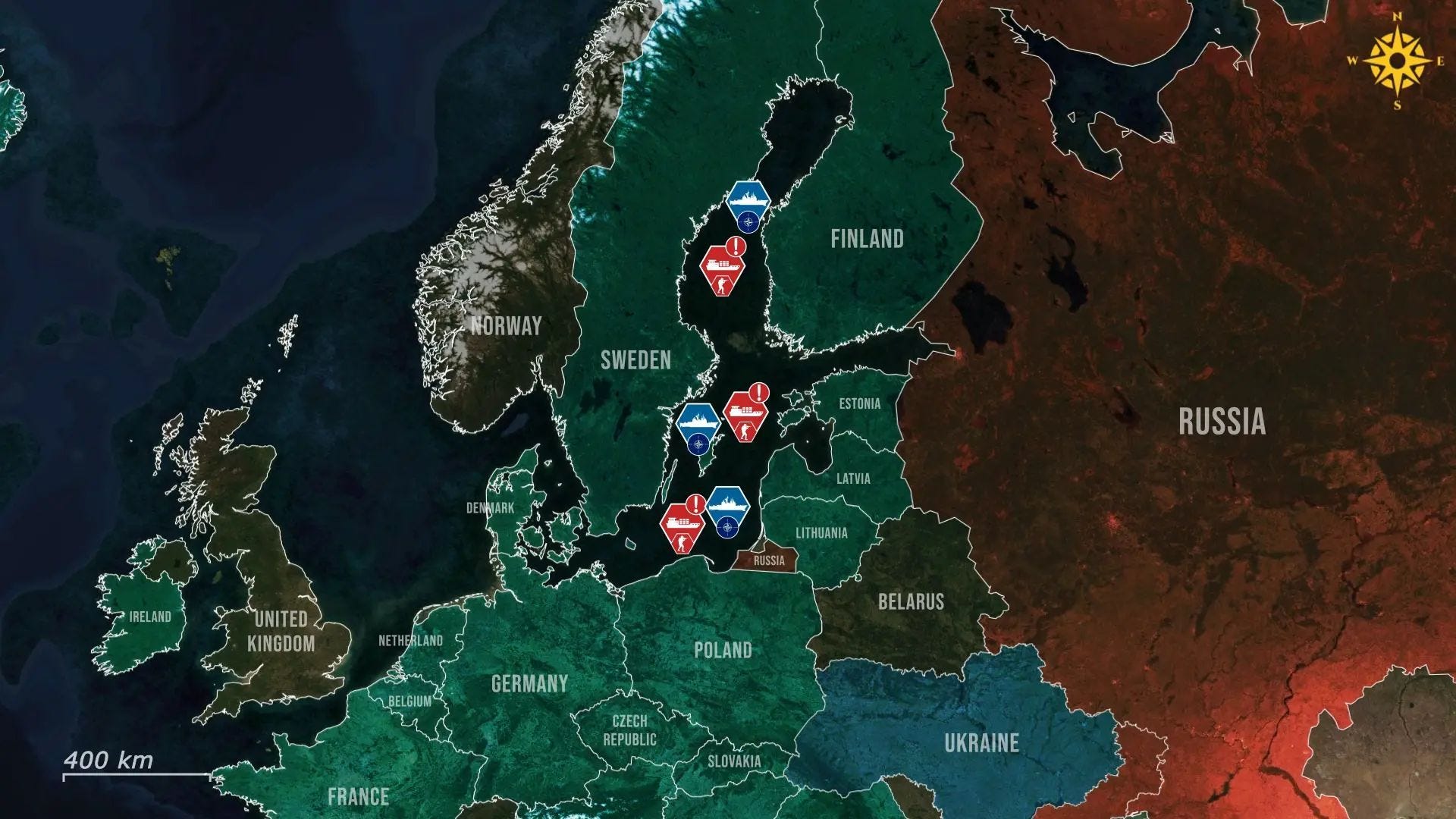
The Barents Observer: Norway bet on democratic development in Russia and invested heavily in building bridges and a major highway connection - both literally and in a political and human sense, with neighbouring Russian regions. It failed.
In stark contrast to the festivity on Bøkfjord Bridge in 2017, Norway is today working on a plan for how to blow up bridges in case of a Russian military attack. Norway spent 880 million kroner (€9,5 million) on the 12-kilometre-long connection, which included also a 685-metre-long tunnel.
According to the newspaper VG, the Norwegian government is in the process of establishing procedures for so-called ‘communication-disrupting measures’ for bridges and other infrastructure.
"Objects that the Armed Forces wish to destroy in wartime, with the aim of delaying enemy advances, must be prepared in peacetime. This increases the effect and reduces the cost," Anders Haavik-Nilsen, a representative of the Norwegian Defence Estates Agency, said to VG.
Kosovo will hold early elections on Sunday due to months of political deadlock and the parties’ failure to form a government after February’s elections.
Albin Kurti, known for his reformist stance, has conducted an extensive campaign ahead of the snap elections after his party fell short in February. Political figure Abdixhiku, leader of the LDK party, has posited that the party could play a crucial role in coalition building, aiming to lead Kosovo with a dignified and European government. Kurti will face international pressure to engage with Serbian President Aleksandar Vucic on normalizing relations if he wins the election.
Italian authorities arrested nine people linked to three charitable organizations and issued international arrest orders for funding Hamas and affiliates.
Interior Minister Matteo Piantedosi said charities presented themselves as initiatives for the Palestinian people while police reported more than 71 percent of donations funded Hamas or affiliates.
Prosecutors described `triangulation operations` that moved illegal funds via bank transfers and organisations abroad to associations based in Gaza, with some money reaching family members implicated in terrorist attacks.
Among those arrested was Mohammad Hannoun, president of the Palestinian Association in Italy, whom prosecutors describe as head of an Italian Hamas cell; the suspects sent about 7 million euros to associations based in Gaza, the Palestinian territories, or Israel linked to Hamas.
The European Union lists Hamas as a terrorist organisation, and the European Council extended restrictive measures against 12 individuals and three entities supporting Hamas and Palestinian Islamic Jihad.
National Post: In recent months — and as recently as last week — separatists have been wooing the Trump administration for support for an independent Alberta. They plan to continue those discussions with the U.S. State Department, and one Alberta Republican even plans to take the campaign further south, to Latin America, to rustle up support for the cause. The idea is to have friends with open chequebooks if (they say “when”) their efforts lead to a “Yes” vote.
Elections Alberta approved a referendum question proposed by the Alberta Prosperity Project (APP): Do you agree that the province of Alberta should cease to be a part of Canada to become an independent state?
“I think it’s important that we put the building blocks for success in place to make sure that when Alberta’s negotiating its independence from Canada, it can do so from a position of strength,” APP co-founder, Jeff Rath said, detailing his recent meetings with U.S. officials in Washington.
Rath said that he and Dr. Dennis Modry, APP’s CEO, were in the American capital last Tuesday, meeting with officials at the Department of State. They discussed how the U.S. could support Alberta independence.
“One of the things that we’d like to see is U.S. recognition of Alberta as an independent country immediately upon a successful referendum,” Rath said, reiterating what he’s told National Post in recent months. (continue)

U.S.-Canada border updates: From Dec. 26, all non-U.S. travelers, including Canadians and NEXUS members, must have photos taken on both entry and exit. Biometric data may be stored up to 75 years, with AI monitoring departures to prevent visa overstays.
Across the Pond and Beyond...Former Russian Foreign Ministry employee Arseniy Konovalov, 38, has been sentenced to 12 years in a maximum-security prison for collaborating with US intelligence, Interfax reported, citing the FSB Public Relations Center. The Moscow City Court also fined the diplomat, who was detained back in March 2024, 100,000 rubles. He was also given a one-year suspended sentence.
PBS: President Donald Trump said Friday that he delayed American military strikes in Nigeria until Christmas Day to deliver a message to groups he alleges are targeting Christians in that country. The Nigerian government praised the attacks and said it provided the U.S. with the necessary intelligence.