
Dec 29: E-Stories
InUkraine CombatSitRep BehindLines Russia-China InEurope Pond&Beyond

Catching up…
For a general view of news from various geopolitical threatres, Scott’s EA Worldview is always superb.
Let’s get going…
Stories we’re following…Ukraine reports another overnight drone attack. Russia launched 48 UAVs, mostly Shahed types, from Russia and occupied Crimea. Air defense units shot down or suppressed 30 drones across the north, south and east. Impacts were recorded at 9 locations.
Video: Emergency services in Kyiv on Dec 27.
IAEA chief Rafael Grossi says a local ceasefire is in place around the Zaporizhzhia Nuclear Power Plant to repair damaged power lines. Repairs have begun and are being monitored by the IAEA, creating a temporary “window of silence” to reduce nuclear risk during the war.
Kherson Oblast Military Administration reported that Russian forces struck residential neighbourhoods and critical infrastructure in Kherson in the morning, leaving part of the city without electricity. At the time, a 75-year-old woman was known to have been injured; she was diagnosed with a blast injury and an acute stress reaction.
Attack on Kyiv: ‘It was horrifying, like an earthquake’ – Kyiv recovering from mass Russian attack that left 2 killed, 32 injured
The attack started with Russia launching several Kinzhal hypersonic missiles, Iskander ballistic missiles, and a group of Kalibr cruise missiles at the capital shortly before 2 a.m. Drones kept attacking the capital throughout the night. The air raid alert lasted for nearly 10 hours. “When it seemed that the terrible night was over, we woke up to a terrifying explosion at eight in the morning,” Tetiana Donets, a Kyiv resident, told the Kyiv Independent.
After more than a day without power, electricity has been restored for 748,000 households in Kyiv, according to DTEK. Energy workers reconnected critical infrastructure and fully restored power across the capital following Russia’s latest attack.
Russia preparing to proclaim future Ukrainian elections rigged, Zelensky says, citing intelligence. Elections have been floated as part of a peace or ceasefire deal that Ukraine has been discussing with the U.S., but voting in the occupied territories complicates the process.
The hourly electricity outage schedules will be in effect tomorrow in most regions of Ukraine. According to Ukrenergo, as of December 28, 2025, most regions have implemented outage schedules for residential customers, while the industrial sector is operating with limited capacity. On Monday, December 29, electricity supply will be regulated by the hour in accordance with these decisions.
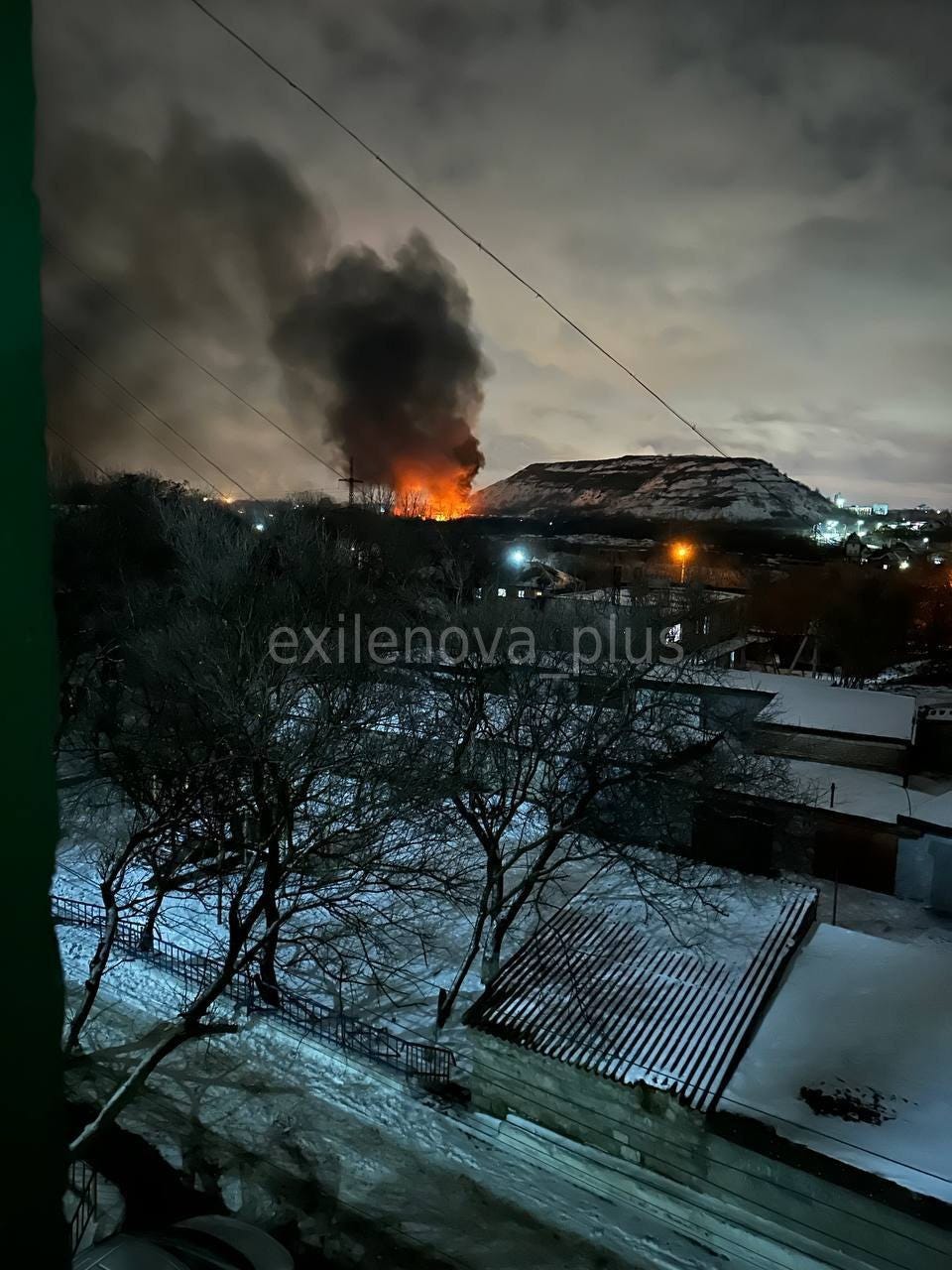
Overnight on Dec 28, cccupied Donetsk was under active Ukrainian drone operations. Multiple explosions are being reported across the city as strikes continue.
Combat SituationThe Armed Forces of Ukraine delivered strikes on three military facilities of the occupier forces in Donetsk and Luhansk regions, according to the General Staff of the Armed Forces of Ukraine on December 28. According to the General Staff, near Antratsyt in Luhansk region, a repair unit from the 1435th motorized rifle regiment of the Russian Federation was destroyed.
Ukraine’s General Staff debunks Kremlin claims of capturing Huliaipole and Myrnohrad. Fighting continues in both. Claims about controlling half of Kostiantynivka are also false. Similar lies were spread about Kupyansk and Pokrovsk.
ISW: Russian forces are currently unable to build out a strategic reserve and will therefore likely be constrained to grinding, slow advances at their current rate and scale in the coming year.
The grinding nature of Russian advances incurs high casualty rates, and Russian forces need incoming personnel to replenish losses in active sectors of the frontlines to maintain a slow but steady rate of advance.
ISW forecasts that Russian forces will continue fighting at their current scale and rate of advance. Russian forces are constrained in the scale and rate of their advances not only by the lack of mobilized military personnel but also because the Russian Ministry of Defense (MoD) has optimized Russian forces for positional warfare instead of focusing on restoring maneuver warfare.
Russian forces cannot currently conduct maneuver warfare at the scale necessary for rapid, operational-level advances. Russian forces are currently unable to address any of the factors complicating its ability to conduct rapid advances or significantly increase its current rate of advance.
Ukrainian forces recently advanced near Kupyansk. Russian forces recently advanced near Hulyaipole.
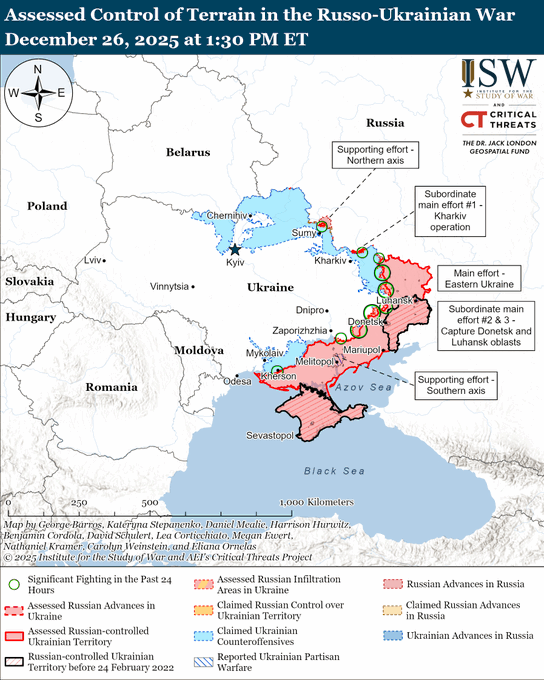
Ukrainian forces continue to degrade Russian capabilities:
Many analysts during the summer 2025 were waiting for a Ukrainian offensive to kick off and were disappointed when Ukraine’s land forces did not liberate significant territory.
What they failed to realise was that the long-range strikes against Russian strategic infrastructure and shipping in the Black Sea and Caspian Sea, including Operation SpiderWeb were operations of the Ukrainian offensive. That offensive continues daily and will increase in the coming months.
Russia's Syzran Oil Refinery under attack by Ukrainian drones, media reports. The Rosneft-owned refinery in Samara Oblast was attacked multiple times in the night, residents claimed. An electrical substation in Syzran was also hit, causing blackouts in the city, affecting central heating in many residents.
Overnight on Dec 27, drones of Ukraine’s 1st Separate Unmanned Systems Center struck multiple military targets in occupied Crimea. Hits were reported on a Valdai radar, a radar reconnaissance command post, and a storage and launch base for Russian uncrewed surface vessels in Chornomorske.
Rail links between Russia and occupied Crimea were disrupted after a freight train derailed overnight in Rostov Oblast. The accident delayed 20 trains, including 7 heading toward Crimea, with delays ranging from 2 to 4.5 hours.
Kushchyovskaya military airfield home to the 797th Training Aviation Regiment in Krasnodar Krai, Russia, was attacked by UAVs during Dec 28 night.
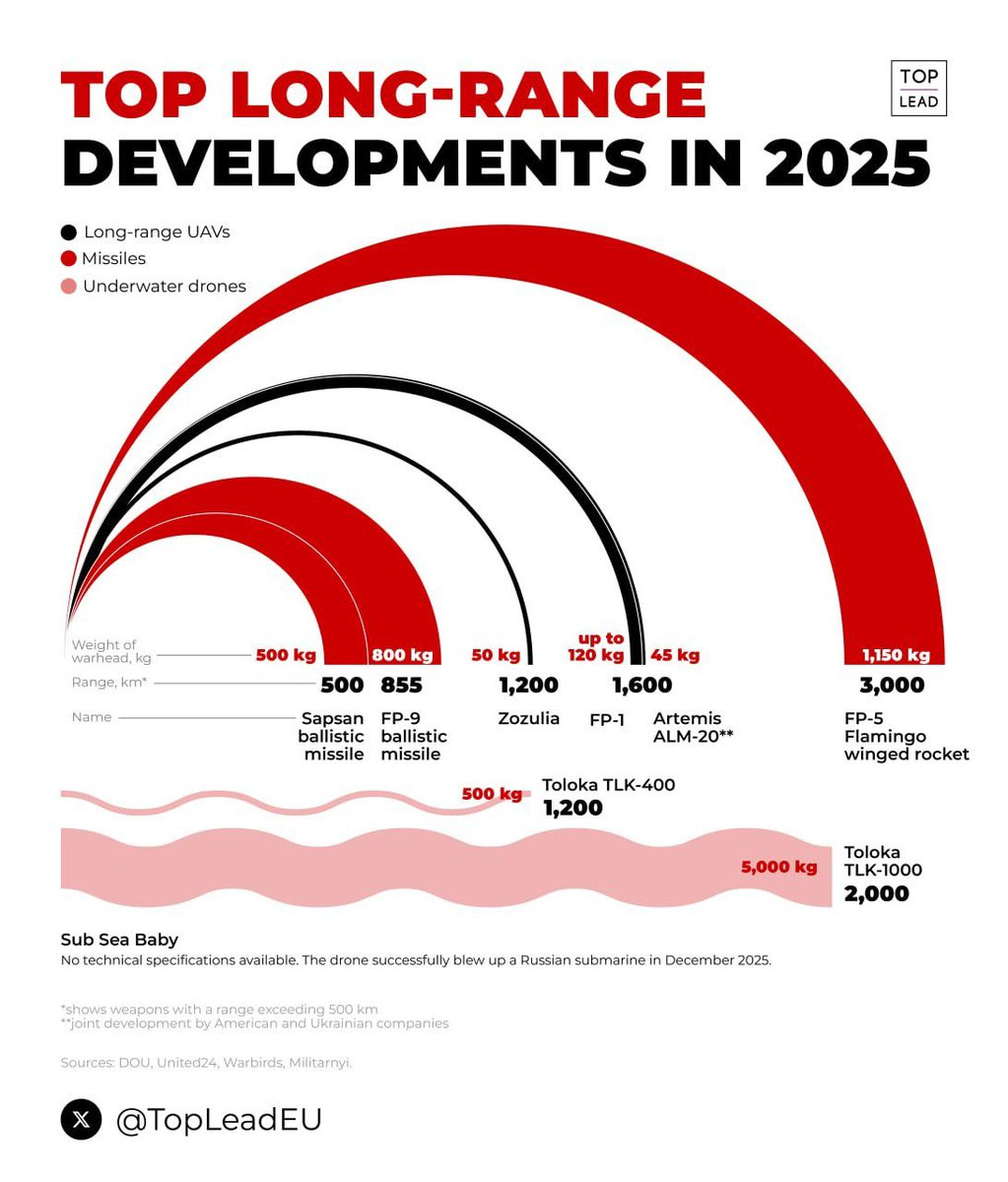
Kyrylo Shevchenko: By the end of 2025, Ukraine's long-range strike capabilities have exploded — from hundreds of km in 2022–23 to thousands today.
Missiles up to 3,000 km, drones reaching 1,600 km, and sea platforms up to 2,000 km. This is no longer experiments — it's a full multi-domain deterrence system across air, land, and sea. Hundreds of millions of dollars go into R&D, testing, and scaling every year. In 2026 the focus will shift to mass production, higher precision, and reliability — making deep strikes a constant factor on the battlefield.
Exilenova: Russian forces seem to be using horses in logistics and assault operations. More and more videos are emerging with horseback offensive attacks across battlefields as well.
In A History of Warfare, John Keegan provides a comprehensive overview of how important horses were for WWII logistics, especially for Germany and the Soviet Union, transporting supplies, ammo, and artillery where motorized vehicles failed due to poor roads, mud, or fuel shortages, with Germany relying on millions of equines (up to 80% of transport in some cases) for movement and power, proving vital for tough terrain like the Eastern Front despite high upkeep costs.
So, nothing really surprising here except for the fact that we’re not in 1941.
Behind the LinesOn December 27, Putin threatened Ukraine prior to Zelensky’s meeting with Trump: if Ukraine refuses Moscow’s terms, Russia will “solve everything by war.” At the same time, the Kremlin claims its forces have captured Huliaipole and Myrnohrad. Another round of intimidation, lies and fantasy victories.
President Zelensky: During our call, we discussed our current progress along the diplomatic track. We went over the most important priorities together. Ukraine values all of the support. Tomorrow, after the meeting with President Trump, we will continue our discussion.
Strong positions are needed both at the front and in diplomacy to prevent Putin from manipulating and evading a real and just end to the war. The world has sufficient strength to guarantee security and peace. Thank you!
Leaders on the video call: Emmanuel Macron (France); Alexander Stubb, (Finland); Friedrich Merz (Germany); Giorgia Meloni (Italy); Mette Frederiksen (Denmark); Donald Tusk (Poland); Dick Schoof (the Netherlands); Jonas Gahr Støre (Norway); Ulf Kristersson (Sweden); António Costa, President of the European Council; Ursula von der Leyen, President of the European Commission; Mark Rutte, Secretary General of NATO; and Jonathan Powell, UK National Security Adviser.
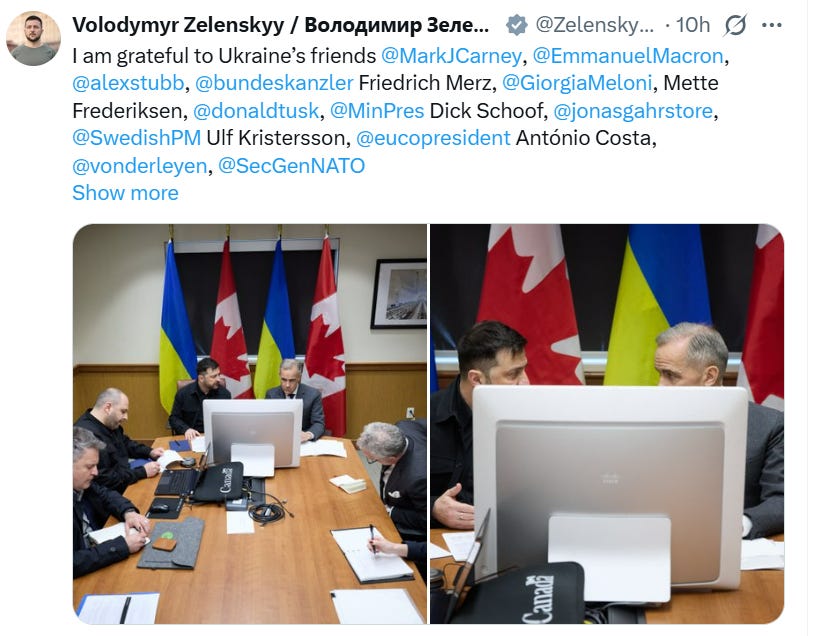
In a press conference with PM Mark Carney, Zelensky says the latest attack is Russia’s response to Ukraine’s peace efforts. “This shows Putin does not want peace. We do. He is a warmonger, but afraid to say it publicly,” Zelensky stated, calling the strikes further proof of Moscow’s real intentions.
He added that security guarantees, timelines and Ukraine’s economic recovery will be central topics in his meeting with Trump. Zelensky stressed guarantees must come with ending the war to prevent renewed Russian aggression, while noting frozen Russian assets alone are not enough to rebuild Ukraine.
The Ukrainian participants Sunday’s meeting at Mar-a-Lago: President Zelenskyy, Rustem Umerov, Economy Minister Oleksii Sobolev, Andrii Hnatov, Oleksandr Bevz, Sergiy Kyslytsya, and Ambassador Olga Stefanishyna. They will be meeting with: Trump, special envoys Jared Kushner and Steve Witkoff. Other members of the administration may also join.
The key topics: 1. U.S. security guarantees; 2. European security guarantees; 3. Ukraine’s prosperity package; 4. the military situation, and; 5. a roadmap for implementing all agreements. Zelensky reiterated on Saturday that the 20-point plan is 90% complete, with the goal now being to finalize it fully. The results of the Sunday negotiations will then be shared with Russia.
Events: A rally, “Do the Right Thing”, organized by the Ukrainian Association of Florida, will take place at 11am ET at the Southern Boulevard Bridge in partnership with local Ukrainian leaders and people across the state, to support Ukraine during the negotiations.
Reminder—Zelenskyy reiterated that he is open to a referendum, but only if Russia agrees to a 60–90-day ceasefire. He suggested holding a vote on the full 20-point document in the form of a simple “YES” or “NO” vote, including territorial issues. Although officially the text of the “territories question” doesn't exist yet, as it has been left for discussion at the presidential level. He also suggested holding presidential elections on the same day, together with the referendum.

The Insider: The Kremlin-backed Matryoshka bot network has launched a disinformation campaign following President Zelensky’s Christmas address, in which he wished death upon an unnamed person. In the statement itself, it was clear from context that Zelensky had in mind Vladimir Putin. However, as the Bot Blocker Project reports, Kremlin-backed accounts began spreading the false story that the target of the Ukrainian president’s “wish” had been none other than Donald Trump.
The bots began mass-distributing videos bearing the logos of major Western media outlets such as AFP. Videos spread by the bots bear the logos of multiple Western media outlets. Some of the falsified footage even claimed that the pope had condemned Zelensky for his remarks. (The Insider has links to the bots’ posts, along with evidence provided by Bot Blocker showing that the accounts belong to the Matryoshka network.)
Mo: This campaign went viral on X on Christmas Eve. It was clear from the networks that were distributing it that it was an information operation.
MAL--The Negotiations that will lead to nowhere...President Zelensky and his delegation were set to meet Trump and his at 1:00pm local time. He landed in Florida at 11:35am ET and reporters noticed that not a single U.S. official to greet Zelensky upon his arrival, which is offensive. Yesterday in Nova Scotia, Zelenskyy was met by Prime Minister Mark Carney when he landed.
Zelensky was met along with way to Mar-a-Lago by Americans waving Ukrainian flags in a show of support. A rally has been organised as well.
Oh dear, it’s getting worse: Ahead of the meeting, Donald Trump said he had “a good and very productive” phone call with Putin, without giving further details about the conversation, which was confirmed by the Kremlin to Russian state media. Ushakov reported that the call last 1 hour and 15 minutes. Just a reminder: Putin said he was “not interested in the pullout of Ukrainian military formations from the territories they currently hold.”
Max Seddon following Russian comments reports that Putin’s foreign policy advisor says Trump agreed with Russia that a ceasefire in Ukraine would only “drag out the conflict and risk the renewal of hostilities.” This takes us back to Alaska, where Trump agreed with Putin to drop calls for a ceasefire before later resuming them.
Putin and Trump agreed to form two working groups focused on a peace deal, to be outlined in January, according to Putin’s aide Ushakov. One will address security, the other economic issues. He also noted the 75-minute call was initiated by Trump.
Washington has drafted a “platinum standard” package (sounds like a credit card), comparable to NATO Article 5, and Trump is willing to take it to Congress. Binding US-backed guarantees are seen as essential to deter renewed Russian aggression.
“This is the most robust set of security protocols they have ever seen. It is a very, very strong package,” a senior US official said, without detailing exactly what the US was promising. Trump is willing to bring the US-backed security guarantees before Congress, a second official said, describing the package as the “platinum standard” for what Washington can offer Ukraine.
Trump at Mar-a-Lago: “I have no deadlines. My only deadline is to end the war.” He added, “I believe both presidents Zelensky and Putin want to make a deal.” Trump added that he would be calling Putin after the meeting with Zelensky.
Those present at the lunch besides Trump: secretary of state Marco Rubio, defence secretary Pete Hegseth, White House chief of staff Susie Wiles, chairman of the joint chiefs General Dan Caine, envoys Jared Kushner and Steve Witkoff and deputy chief of staff Stephen Miller. The Ukrainian delegation: Rustem Umerov, Andriy Hnatov, Serhiy Kyslytsya.
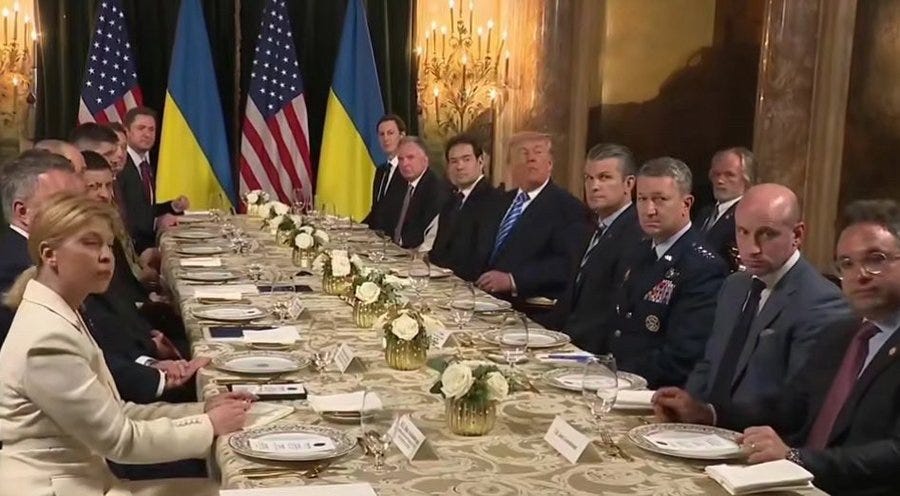
The post-meeting official statements and results will be in Tuesday’s E-Stories.
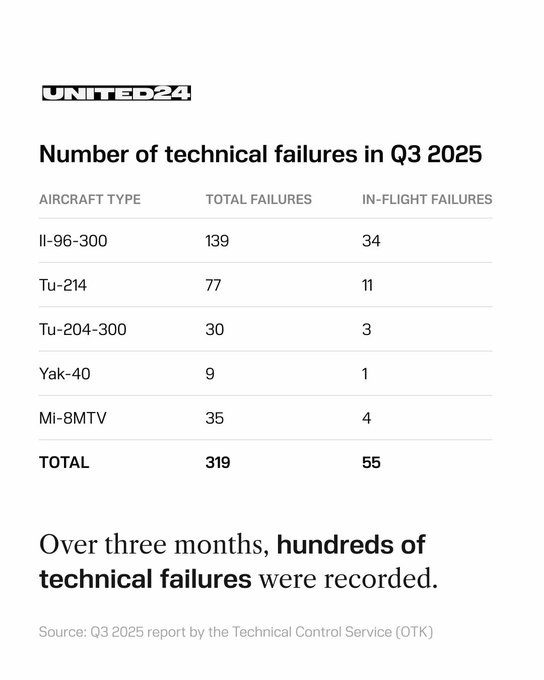
Meanwhile in Russia & China…United24: Russia Cannot Ensure the Safety of Its Most Important Aircraft. For years, Russian authorities have insisted that sanctions have failed to seriously affect key sectors of the economy and the defense industry. However, internal documents from Russian state institutions obtained by United24 Media reveal a very different reality: Russia is gradually losing the ability to safely operate and maintain its most important aircraft, including those used to transport the country’s top leadership.
Despite the fact that Russia has poured tens of billions of dollars into its aviation sector, the documents show a steady degradation of the entire industry. Shortages of components affect not only foreign-made aircraft, but also Soviet- and Russian-designed models. This is not about isolated incidents or temporary difficulties. The documents indicate that these problems are already systemically manifesting during flight operations.
The documents obtained by journalists are internal service memoranda and reports prepared in 2024–2025 for government meetings and interagency discussions. They were not intended for public release and contain direct assessments of the technical condition of aircraft, the progress of import substitution programs, and statistics on actual equipment failures.
The most significant among them is a report by the Technical Control Service (OTK) for the third quarter of 2025, which records the number of technical failures on state-operated aircraft, including those that occurred directly during flight.
The Insider: Russian authorities are reducing spots at universities and steering applicants toward engineering programs relevant to the defense industry.
On Dec. 22, Russia's Minister of Education and Science Valery Falkov announced that in the academic year 2026–2027, the ministry plans to cut about 13% of all non-subsidized spots at Russian universities (approximately 45,000 places). “These are, of course, in economics, management, public and municipal administration, and law. The labor market does not need this many specialists,” the minister said.
The Ukrainian drone attack on Moscow, which began on the evening of December 27, paralyzed operations at several of the capital's airports. A total of approximately 290 flights were delayed at Vnukovo and Sheremetyevo, according to RBC, citing the online flight schedule. Another 80-plus flights were diverted to alternate airfields.
Russian authorities will not block VPN services in 2026, as this technology cannot be fully controlled. This was stated by Sergei Boyarsky, head of the State Duma Committee on Information Policy, Information Technology, and Communications, in an interview with RBC. "This is a technology that cannot be curbed. We understand this perfectly well... therefore, VPNs will not be restricted in any way," the parliamentarian said, urging Russians to "be more careful and cautious" with VPN services, as they, he said, can be "downright dangerous." (Mo: So, Russian citizens do know what is happening in Ukraine.)
Russian citizens will respond positively to an increase in taxes in 2026 if the money raised is used for war. This was stated by President Vladimir Putin at a State Council meeting in the Kremlin on Thursday.
"If we not only talk about increasing the fiscal burden, but also work together to reduce 'gray' areas in the economy, […] if we provide targeted support to critically important industries and enterprises, fulfill all social obligations to the people, and address issues of ensuring the country's security and defense capability, this cannot but have a positive impact on the situation in the country as a whole and the financial well-being of our citizens," Putin said.
The Insider: Russia’s Arctic LNG 2 receives a powerful ice-class tanker that can ship gas in winter, transferring it to the shadow fleet
Russia’s Zvezda Shipbuilding Complex has delivered the country’s first fully home-built liquefied natural gas carrier. According to Rosneft’s press service, the Arc7 ice-class vessel Alexey Kosygin will be the lead ship operating in the Arctic LNG 2 project.
“The LNG carrier is capable of operating independently in the Arctic, breaking through ice comparable in thickness to the height of a single-story house. The vessel has a capacity of more than 172,000 cubic meters of liquefied natural gas and is equipped with a 60-megawatt power plant, equivalent to 80,000 car engines producing 100 horsepower each. Such vessels will make it possible to transport LNG along the Northern Sea Route year-round, ensuring stable logistics for Arctic projects,” the statement said.
Nexta: Russians will keep bombing Ukraine until it becomes “friendly”
“We just need to make sure this moment comes closer,” Deputy Foreign Minister Ryabkov said.
“I would very much like to see Ukraine as a country friendly to Russia. A country where the rights of Russians and Russian-speakers are fully restored and guaranteed. Where the rights of the canonical Russian Orthodox Church are restored. Where there is care for people, and not just a totalitarian line that allows absolutely no deviations and aims to eliminate everything-everything-everything.”
The Barents Observer: Vladislav Yapuntai was killed in Ukraine
Vladislav Yapuntai is one of several hundred men from small indigenous communities in the Yamal-Nenets region that have been killed in Russia's war of aggression.
Paradoxically, representatives of the indigenous peoples of the north, themselves victims of Moscow's repressive imperialism, are active participants in Putin's expansionist war of aggression.
Judging from a database with information about Russian soldiers killed in Ukraine, Vladislav Yapuntai is one of at least 17 men of the Yapuntai family that have perished in the war. Yapuntai is a common surname in the Nenets region.
Other common Nenets surnames are Salinder and Khudi. The database includes information about at least 35 men of the Salinder family and 22 men of the Khudi family. Many of them came from reindeer-herding families. Many of them would have carried on local traditions and reindeer husbandry in their villages.
Among the villages that have lost most men is Gyda, a settlement located in the northernmost part of the Gydan Peninsula. At least 34 men from Gyda have been confirmed killed. Among the towns and villages with a high death toll is Tazovsky. The town is located on the coast of the Ob Bay and has a population of about 8,400.
Men from ethnic minorities living far from Moscow make up a significant share of the troops that are fighting and dying on occupied Ukrainian land.
Recruitment is actively supported by local and regional authorities. In the municipality of Yar-Sale, a Nenets town located on the shores of the Ob Bay, the town administration frequently posts pro-war materials and recruitment ads on its social media.
“Many indigenous groups are poor and troubled by economic depression, and federal authorities have never made any major effort to improve their position,” Andrei Danilov told the Barents Observer. According to Danilov, indigenous communities are vulnerable and the loss of young local men can have big consequences for the group.
Taiwan Plus News: Taiwan's main opposition Kuomintang Chair Cheng Li-wun has revealed that her party has been in communication with the Chinese Communist Party, and that she hopes to visit China and meet with Xi Jinping early next year.
Bloomberg: China has officially launched a national venture capital fund and three large regional funds, together worth billions of dollars, as part of a push to foster home-grown tech champions. The national fund will run for 20 years — with 10 years devoted to investment and another 10 to exits.
The national fund is backed by 100 billion yuan from the Ministry of Finance and the three regional funds are each expected to eventually grow to more than 50 billion yuan. The national fund will target smaller companies with valuations of no more than 500 million yuan and prioritize strategic emerging and future industries such as integrated circuits and biomedicine.
France24: China is forcing debt ridden countries to give unlimited and unrestricted fishing rights in their waters in exchange for debt repayment concessions. Burdened under Chinese debt, Senegal forced to give fishing licences to vessels of Chinese fishing companies involved in illegal, unreported and unregulated fishing activity in recent years.
Reuters: Russia would back China in a potential war over Taiwan, according to FM Sergey Lavrov. Moscow again rejected any form of Taiwanese independence, calling the island an inseparable part of China. The statement comes as Beijing tests new hypersonic anti ship weapons and Russia warns Japan over its shift toward militarisation.
CSIS: Lights Out? Wargaming a Chinese Blockade of Taiwan
Since 2022, China has conducted numerous military drills and exercises simulating blockades of the island of Taiwan, a democracy of 23 million that sits astride one of the world’s maritime chokepoints. What would happen if China initiated a blockade of Taiwan in the coming years? To understand the military challenges in countering a blockade, CSIS ran 26 wargames using a wide variety of scenarios.
Although China could inflict serious hardships, particularly by targeting Taiwan’s energy sector, this wouldn’t be a low-risk, low-cost option for Beijing. Any blockade creates escalatory pressures that are difficult to contain and could lead to a large-scale war. Building on existing preparations, Taiwan and the United States could strengthen deterrence by demonstrating that a blockade is not feasible.
This report is funded by a grant from the Smith-Richardson Foundation with assistance from the Diane Davis Spencer Foundation.
Katie Shoshiashvili—Tbilisi, Georgia: Large crowds are marching through the streets of Tbilisi on Saturday.
Demonstrators include students, teachers, journalists, artists, and family members of prisoners of conscience, faced with repression, intimidation and total dismantlement of democracy and human rights in the country.
Georgia is closing one of the most brutal years in its recent history for civil society and its citizens. Hundreds have been jailed or subjected to torture. Independent and civil media spaces have been systematically shut down. Fundamental freedoms and human rights have been curtailed and dismantled, pushing the country into isolation and cementing its alignment with Russia.
This marks Day 395 of the Georgia Protests. Video credit: MOSE
In Europe…Polizia di Stato—Terrorism: Hamas network in Italy targeted, nine arrests and €8 million seized
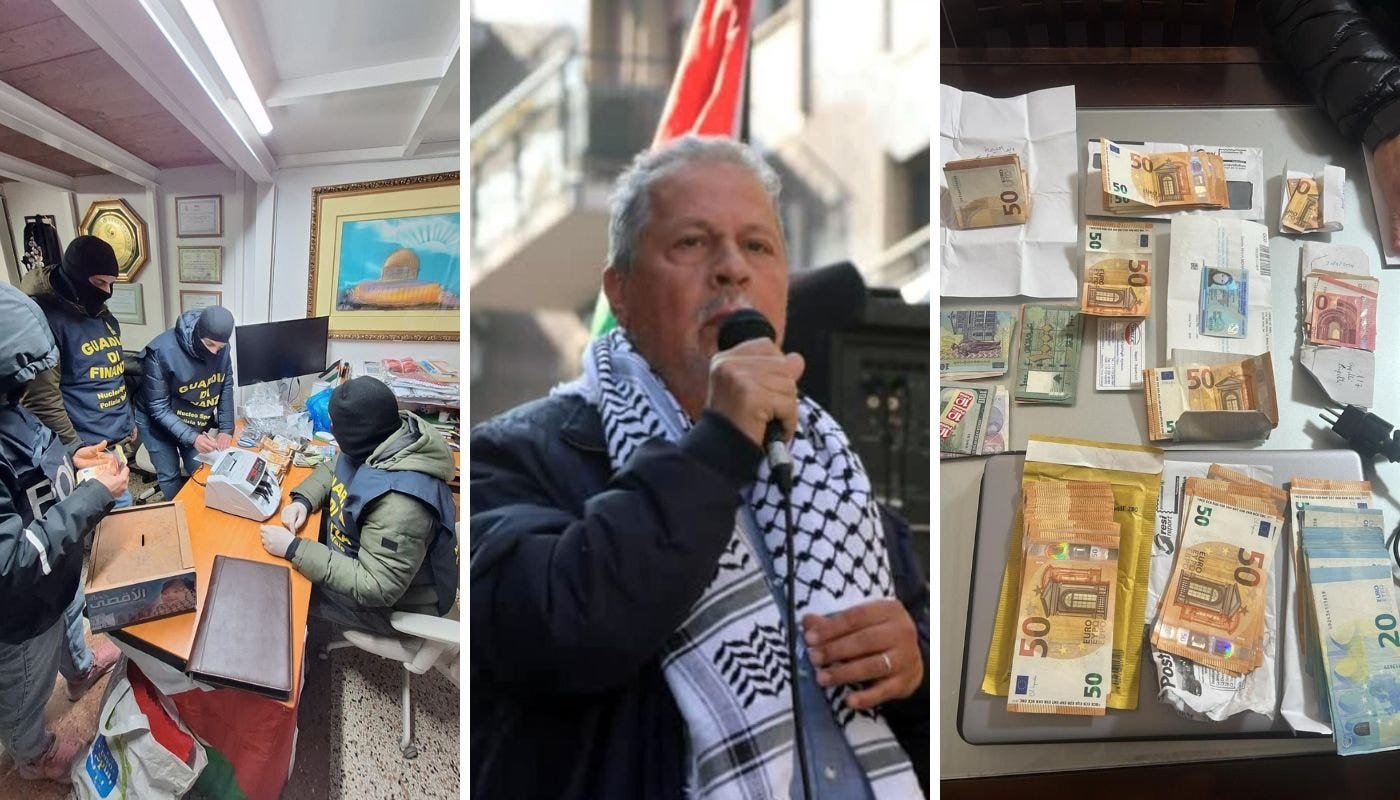
At the end of Operation “Domino,” nine people were arrested by DIGOS police officers, in coordination with the Central Directorate of Prevention Police and the Guardia di Finanza of Genoa, accused of being members of and having financed, through charities in solidarity with the Palestinian people, the terrorist organization Hamas, the Islamic resistance movement.
The investigation, coordinated by the District Anti-Mafia and Anti-Terrorism Directorate (DDA) of Genoa, began immediately after the terrorist attack attributed to Hamas carried out on 7 October 2023, Thanks to the impetus of the National Anti-Mafia and Anti-Terrorism Directorate, the investigation began with an analysis of a series of reports of suspicious financial transactions identified before October 7, 2023, involving some of the suspects.
The suspects are specifically accused of carrying out financing operations believed to have contributed to terrorist activities, amounting to approximately seven million euros.
Among those arrested, identified by investigators as members of the foreign branch of the terrorist organization Hamas, are the leader of the Italian terrorist cell, as well as the representatives and members of several branches present in Italy.
Mo: The arrests have caused a political stir in Italy. Mohammed Hannoun and his group have received support from members of the Democratic Party (primarily Laura Boldrini), the Five Star Movement (such as Stefania Ascari and Gaetano Pedullà), and Alessandro Di Battista, as well as from personalities and associations who have consistently supported his organizations and launched dedicated campaigns to delegitimize those who, both politically and journalistically, have rigorously reported on the findings of this investigation. That said, Hannoun’s activities were well-known in Italy starting from 1991 and continued even though he received an expulsion order from Italian authorities.
Euro MEP Pina Picierno had submitted a parliamentary interrogation to the European Commission in 2021 regarding the activities of Mohammed Hannoun and his associative network, highlighting the concrete risk that associations which appear to be humanitarian in nature were in reality vehicles for the financing and propaganda of Hamas but to no avail.
Those arrested besides Mohammed Hannoun: “Ra'Ed Hussny Mousa Dawoud was the operational contact for the Milan branch of the Charitable Association for Solidarity with the Palestinian People (ABSPP), and was responsible for local management of initiatives and contacts. Riyad Abdelrahim Jaber Albustangi and Yaser Elasaly were involved in promoting fundraising campaigns and organizing events presented as humanitarian. Raed Al Salahhat, a member of Hamas's foreign branch and a leading figure in the European Palestinian Conference, represented the direct link to the network's European dimension. Osama Alisawi, former Minister of Transport in the de facto Hamas government in Gaza, was identified by investigators as one of the final recipients of the funds raised in Italy” writes Max Coccia who has been investigating the network for many years.
Coccia adds that “Italy emerges not as an isolated terminal, but as one of the nodes in a European network involving Germany, France, Belgium, and Spain, following a pattern already identified in other continental investigations.”
European Commission: No internet? No problem.
Just like border-free travel across the EU, staying connected has never been easier, thanks to EU roaming and the WiFi4EU app.
The WiFi4EU initiative provides free Wi-Fi connectivity in public spaces across Europe, thanks to the successful deployment of over 93 000 hotspots by more than 7 200 municipalities that were awarded a voucher. Our new app is designed to make it easier than ever to find these hotspots.
With the WiFi4EU app, you can access high-speed, reliable Wi-Fi at thousands of locations throughout Europe, specifically in the municipalities that have deployed free WiFi4EU hotspots in public spaces like parks, squares, public buildings, libraries, health centres or museums. Whether you’re traveling for work, vacationing, or simply out and about in your local town, the WiFi4EU app will help you enjoy internet access wherever you go—without the burden of data charges.
Paul Krugman talks with Adam Tooze about Europe's current state. They discuss migration, economic trends, and the rise of the far right, comparing these to similar issues in the US. The conversation explores the complexities of Europe's political and economic landscap
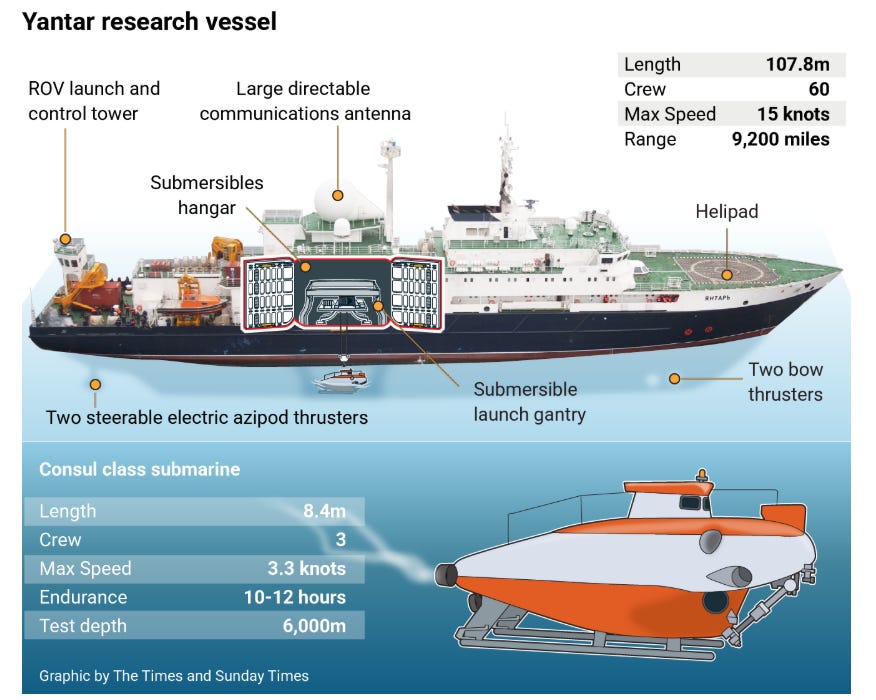
The Times: Russian submarines are secretly being deployed alongside Moscow’s best-known spy ship to map critical undersea infrastructure around Britain, raising fears of potential sabotage.
Defence sources have revealed that in November last year a submarine shadowed the Yantar, a Russian vessel officially described as a research ship, as it surveyed a gas pipeline linking Britain and Ireland.
A newly declassified image of the encounter has been released to The Sunday Times, showing the navy’s submarine and an anti-submarine Merlin Mk2 helicopter during the incident in the Irish Sea.
Last week the head of the Royal Navy, General Sir Gwyn Jenkins, warned that Russia was renewing investment in its elite deep-sea submarine division, known as GUGI, giving Moscow the option to use “physical action” against the UK and its western allies.
Senior British defence sources said Russia may be intensifying so-called grey-zone operations in waters around Britain and Ireland because it is being pushed out of the Mediterranean and now the Baltic Sea — the latter due to Finland and Sweden’s accession to Nato.
UK armed forces are also worried that Russia is attempting to exploit Ireland’s military neutrality — it is not in Nato and is one of the lowest defence spenders in Europe — to expand its footprint close to the UK. Three senior British figures said independently of one another that Ireland was seen as the “soft underbelly”. (continue)
TVP: Polish scientists at Gdańsk University of Technology developed the Stratus system using powerful electromagnetic pulses to instantly disrupt or destroy drone electronics, creating an invisible shield without physical explosions, as reported by TVP World, with successful lab tests but no operational deployment yet, funded by over 21 million zlotys for protecting critical infrastructure amid rising drone threats.
The Insider: On Dec. 15, the European Union imposed sanctions on the International Russophile Movement, or IRM.
Few people had heard of it, but over the past three years it has effectively replaced official pro-Kremlin organizations formerly operating in the EU, where life for them became far more difficult after Russia launched its full-scale invasion of Ukraine in 2022.
The Russian World Foundation, the Gorchakov Foundation, and Pravfond — all controlled by Russia’s Foreign Ministry — faced sanctions, asset freezes, staff expulsions and increased oversight. As a result, the IRM emerged in 2023 under the auspices of the Foreign Ministry and Konstantin Malofeev, a billionaire fraudster with ties to Russian intelligence services.
Although the movement is publicly presented as a grassroots initiative made up of EU citizens, in practice the IRM is backed by several Kremlin influence networks.
The “Russophiles” openly said they feared sanctions and did not plan to create legal entities, but that did not help. The new structure appears headed for the same inglorious fate as the earlier Kremlin puppet organizations that were sanctioned after the start of the full-scale invasion of Ukraine.
CBC News: President Zelenskyy met with PM Mark Carney in Halifax on Saturday during a stopover before heading to the U.S. to meet with President Donald Trump for talks aimed at ending the Russia-Ukraine war.
The prime minister also announced an additional $2.5 billion of economic aid for Ukraine. $1.6 billion of the newly announced aid comes in the form of loan guarantees to the World Bank's International Bank for Reconstruction and Development and the European Bank for Reconstruction and Development.
Across the Pond and Beyond...PBS: The Trump administration says it plans to dismantle the National Center for Atmospheric Research in Colorado, which is the nation’s premier atmospheric science center. In his announcement of the closing, OMB Director Russell Vought called the center “one of the largest sources of climate alarmism in the country.”
NCAR, as the center is known, was founded in 1960 and has facilitated generations of breakthroughs in climate and weather science. The announcement has drawn outcry from meteorologists and climate scientists across the country.