
Dec 30: E-Stories
InUkraine CombatSitRep BehindLines Russia-China InEurope Pond&Beyond
Catching up…
For a general view of news from various geopolitical threatres, Scott’s EA Worldview is always superb.
Let’s get going…
Stories we’re following…Ukraine’s air defense shot down or suppressed 21 out of 25 Russian drones during the early hours of Dec 29, including Shaheds and other types launched from multiple directions. Strikes were recorded at two locations.
December 29, Russian troops attacked Orikhiv in Zaporizhzhia Oblast with KAB bombs. One person was killed, and another was injured. According to Ivan Fedorov, head of the regional military administration, the deceased was a 46-year-old man, and the injured was a 49-year-old woman. She is receiving the necessary medical care.
Since the start of 2025, Russia has carried out 90 combined strikes on Ukraine’s port infrastructure, double the level of the same period last year. According to Oleksiy Kuleba, Deputy Prime Minister for the Recovery of Ukraine – Minister of Development of Communities and Territories, missile and drone attacks on Ukrainian ports are effectively recorded almost daily, signaling an intent to disrupt logistics, hinder exports, and undermine global food security.
On the night of December 29, Russian troops carried out strikes on the Nikopol and Synelnykivskyi districts of Dnipropetrovsk Oblast, causing several fires. The information was confirmed by Vladyslav Haivanenko, the acting head of the regional military administration, in his statement.
Russian occupiers have reopened the Mariupol Drama Theatre, where hundreds of civilians, mostly women and children, were killed in a Russian airstrike in March 2022. After taking control, they did not allow any neutral investigation or recover all bodies. International human rights organizations documented the attack and classified it as a war crime. (Mo: this makes me literally sick.)

Former Commander-in-Chief Valerii Zaluzhnyi is allegedly preparing to step down as Ukraine’s ambassador to the UK in early January, Radio NV reports. While no next role is confirmed, sources say he previously discussed options with Zelensky. The move comes amid persistent rumors that Zaluzhnyi may run for president and challenge Zelensky.
FAO, in close cooperation with the Government of Ukraine, is launching a three-year program to support farmers that will combine emergency assistance with long-term restoration of rural agriculture.
Trump: “Russia’s going to be helping. Russia wants Ukraine to succeed”. At the joint-press conference in Florida, Trump said that in his phone call with the Kremlin, Putin said he wanted Ukraine to succeed and is ready to provide cheap oil and gas. President Zelensky’s reaction to these statements is priceless as is ours.
For more on the results of the Florida talks, see the section “Behind the Lines”.
Luke Harding: a group of volunteers and neighbours are trying to save Kyiv’s architectural heritage amid waves of intense Russian attacks. Here is an extract from his piece:
Saving Kyiv’s architectural heritage seems strange at a time when Russian missiles and drones routinely fall on the capital, bringing death and destruction. Since the beginning of 2025, the Kremlin has dramatically stepped up its aerial raids. After each attack, workers board up shattered windows with plywood and try, where possible, to save residential buildings…
But Russia is only one threat. Preservation campaigners say they face unscrupulous developers who knock down listed buildings, corrupt officials and a governing class indifferent or hostile to the city’s rich architectural history. The harsh winter climate adds another burden.
“Kyiv is a city where money wins. We don’t have real political will to save our heritage,” said Dmytro Perov, an activist with the Heritage Kyiv group. He claimed the city’s mayor, Vitali Klitschko, was friends with many of the developers who bulldoze important houses.
“Klitschko lives in an illegal building with a striptease club. His vision for the capital comes straight out of the 90s and Tony Soprano,” he alleged. Klitschko denies the claim, which he says comes from political rivals.
Office of the Ukrainian Obudsman: Russian Propaganda and Child Militarization in Occupied Kherson Exposed
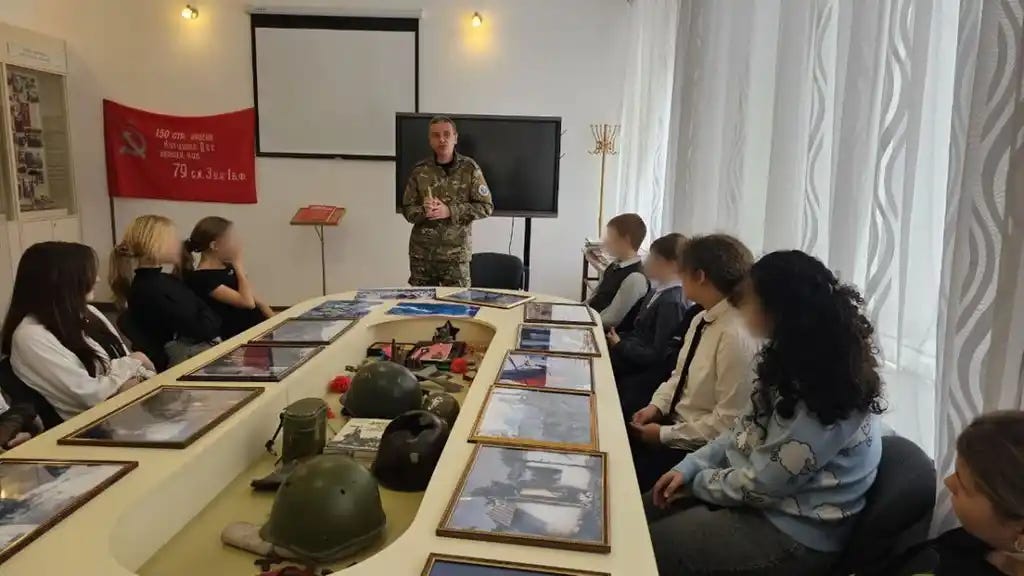
November 2025 in the occupied part of Kherson region: in Skadovsk, at the museum, a “Lesson of Courage” for students of School No. 3 took place, led by Andriy Dvoretsky – a former journalist from Mykolaiv who in 2014 switched to Russia’s side. The investigation reveals Dvoretsky’s biography and the activities of the Russian organization “Military Brotherhood,” which militarizes children in the temporarily occupied territories.
During the event Dvoretsky presented 16 photographs from his authorial exhibition “The Long Road Home” and spoke about his role in promoting pro-Russian narratives among the youth.
According to materials from the investigation, the regional branch of “Military Brotherhood” in Skadovsk is headed by Dvoretsky himself, and the organization’s projects cover “patriotic, educational” events, including “lessons of courage,” military-sport competitions, and camps for youth. During the existence of the regional formation its participants allegedly conducted more than 600 such lessons.
In September 2025, as part of this activity at School No. 3 they opened the so-called “Cossack class,” and as part of cooperation with the occupying authorities, regional branches of the organization support educational institutions and hold events promoting Russian propaganda and the militarization of children.
The Security Service of Ukraine (SBU) announced two charges against Dvoretsky: in July 2023 – for collaboration activities, in April 2024 – for distributing materials with calls to change Ukraine’s state border. In May 2025, the Snihurivskyi District Court in absentia sentenced him to 12 years of imprisonment with confiscation of property; the verdict took effect in June 2025.
The investigation also emphasizes that the activities of the “Military Brotherhood” are regional: in Crimea, Luhansk, Donetsk, Zaporizhzhia and other occupied areas, where heads of the respective branches promote propaganda and organize training with tactical preparation for children.
Combat SituationOn Sunday at the front, 209 combat clashes between the Armed Forces of Ukraine and the Russian invaders were recorded. The data were provided by the General Staff of the Armed Forces of Ukraine in a briefing as of 08:00 on December 29, transmitted by Ukrinform.
Russian air strikes hit Pid Havrylivka, Pokrovske, and Havrylivka in the Dnipropetrovsk region; Varvarivka, Verkhnii Ters, Rizdvyanka, Vozdvyzhivka, Zaliznychne, and Lyubitske in the Zaporizhzhia region.
The Ukrainian artillery destroyed two areas of enemy concentration where personnel, equipment, and enemy hardware were concentrated.
The 1st National Guard Corps “Azov” reports the results of its Dobropillia offensive operation: from August 4 to December 29, Russian forces suffered 12,492 killed, 8,346 wounded, and 185 captured. Ukrainian forces also destroyed or damaged 93 tanks, 259 armored vehicles, 314 artillery systems, over 1,800 vehicles, and 3,579 drones. Around 175 km² of territory was liberated and nearly 195 km² cleared of sabotage groups.
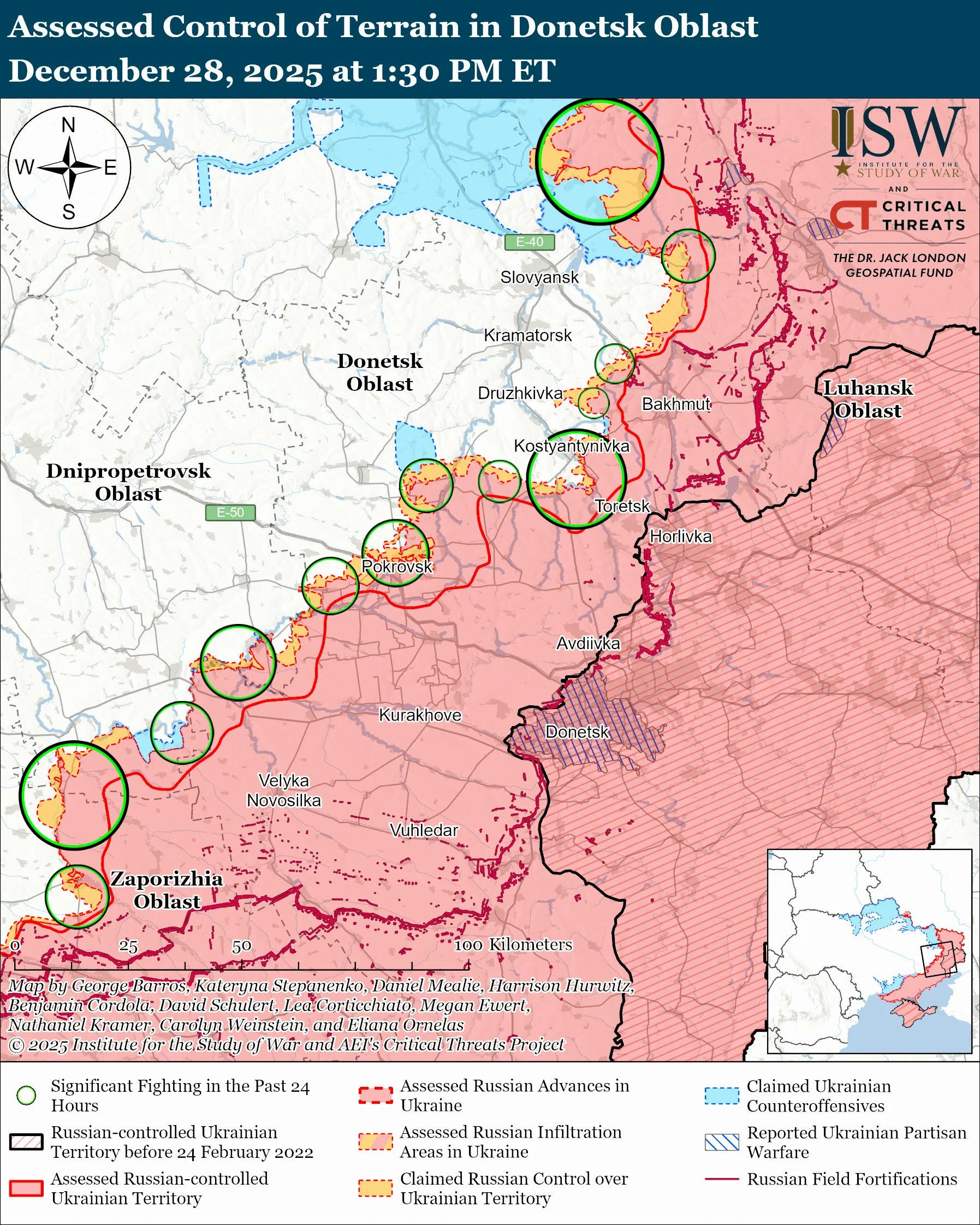
ISW: As of Dec 28, the Russian army operates on less than half of Myrnohrad’s territory and continues to spread statements about advances that are not always corroborated by open-source data. The assessment is based on analysis of new materials from testimonies and geolocated video recordings regarding Rodynske and Myrnohrad.
Putin and the commanders continue to falsely portray future Russian efforts to seize the Fortress Belt in Donetsk Oblast as a quick and easy endeavor. The Fortress Belt consists of four heavily fortified major population centers – Kostyantynivka, Druzhkivka, Kramatorsk, and Slovyansk – that make up the backbone of Ukraine’s defense in Donetsk Oblast.
Ukrainian forces degrade Russian capabilities:
Parts of Tuapse and Kovrov in Vladimir region were left without electricity on Sunday night. Locals heard “explosions” before the power went out.
Overnight on Dec 29, drones struck the Khanskaya airbase in Adygea. In Tula, Russia declared a missile alert, reporting 14 explosions and claiming to have intercepted a ballistic missile.
Behind the LinesPresident Zelensky shared the remarks he made at the start of the joint news conference earlier, starting with thanking Trump once again for a “wonderful meeting” at Mar-a-Lago today:
We had a meaningful discussion on all issues and highly appreciate the progress made by the Ukrainian and American teams over the past few weeks.
We discussed all aspects of the peace framework and achieved significant results. We also discussed the sequence of further actions.
We agree that security guarantees are key to achieving lasting peace, and our teams will continue to work on all aspects.
He also reiterates that the Ukrainian and US teams will meet next week to “finalise all discussed issues” and that Trump has also agreed to host Ukrainian and European leaders in Washington in January.
Other statements from the presser:
Trump: “I think land is the main issue. Some has been taken, some maybe up for grabs, maybe taken in the next few months. You’re better off making a deal now,” he said, looking at Zelensky. “Ukraine has fought hard and brave. Russia wants it to end too. A lot of brave people have died, unfortunately.” (Mo: Land. He is reducing international affairs to a land grab.)
“In a few weeks we’ll know. It could go well or poorly, and if it goes really poorly, it won’t happen at all, which would be a shame. One item could break it up. It’s all very detailed. I’ve settled 8 wars, some going on for decades. We’ll get it done. I saw an interesting Putin today, he told me strongly, ‘I want this done as well.’”
“If no breakthrough is made, they keep fighting and they keep dying. Zelensky doesn’t want that, and neither does Putin. But that’s what happens.”
On his call with Putin, Trump said they discussed rebuilding Ukraine: “He wants Ukraine to succeed. He was very generous, especially about energy exports at low prices. Still in the works.”
President Stubb says he had an hour-long call with Trump, Zelensky, Macron, Starmer, Meloni, Merz, NATO’s Rutte, von der Leyen and others. They discussed concrete steps to end the war, aiming for a just and lasting peace.
Zelensky proposed that Trump grant Ukraine long-term security guarantees lasting 30 to 50 years, calling it a potential “historic decision” by the U.S. president. “The war has already lasted nearly 15 years,” Zelensky said. Trump responded that he would consider it. The two also discussed strong U.S. guarantees for Ukraine’s future, which Zelensky disclosed to the press: the U.S. would provide a security guarantee for 15 years.
On the 20-point document: "Two questions remain. They are how the Zaporizhzhia Nuclear Power Plant will function and the issue of territories. These are the two questions that remain in the 20-point document."
Zelensky added that January meetings with the U.S. and European partners could pave the way for negotiations with Russia. Talks will begin at the advisor level and progress to leaders, including a planned “Coalition of the Willing” summit in Paris. “If all goes step by step,” Zelensky said, “we will eventually meet with the Russians.”
If Russia refuses the plan, Zelensky has said that the United States and Europe will keep providing assistance to Kyiv:
“There is no alternative to peace. We share a single, unified position with the Americans: the war must be ended through diplomacy, by putting pressure on Russia. Otherwise, the war will continue.”
“And, of course, if the war continues, the Americans, together with the Europeans, will continue to support Ukraine because we are defending ourselves in this war, we are fighting, and we are not the aggressors,” he added.
Mo: How can we take the Potemkin negotiations seriously?
I have difficulty writing about these ‘negotiations’ and taking them seriously because Russia has never deviated from the original 28-point proprosal that was presented in Turkey in March 2022. Nor will it agree to a ceasefire.
The Kremlin’s position was reiterated in Alaska in August 2025, and once again (just in case you missed the other 50 times) in the run up to these ‘negotiations’ by Russia’s foreign minister, the deputy foreign minister, Russian state propagandists and proxies as well as by Steve Witkoff, the American real estate dealer (video timestamp: 55:00-1:26:00).
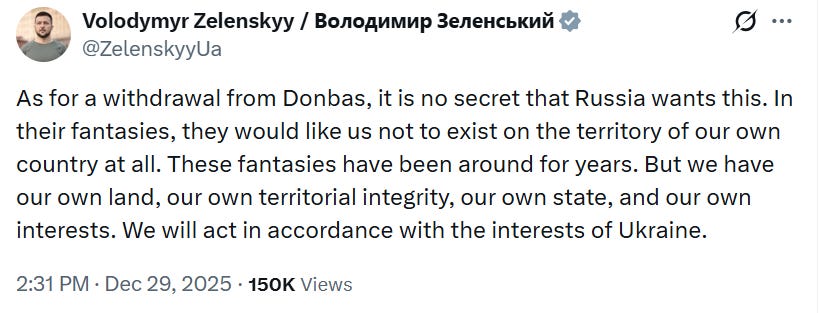
Post-Mar-a-Lago, Kremlin spokesman Peskov reiterated Russia’s position once again: “Ukraine must withdraw its troops from Donbas to end the war.”
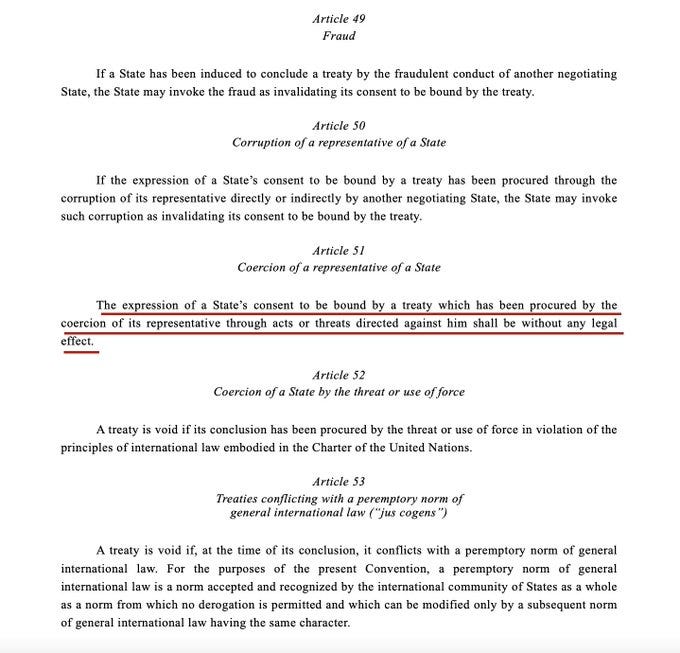
These are Potemkin ‘negotiations’: It’s a show with all the bells and whistles but there’s nothing to them. They will lead to nowhere but do serve to divert our resources and attention to endeavours that don’t make a dent in the current war. The Kremlin knows it will never agree to an agreement with Ukraine—unless it’s total subjugation—never mind abide a treaty of any sort.
What is extraordinary is that the negotiations were allowed to move forward at all: Russia and its forces have attacked Ukraine, changed international boundaries and actively seeks to eradicate Ukrainian statehood and citizens every single day. Just in this war, the Kremlin has committed countless war crimes and violated numerous international laws it said it would respect. I won’t even mention the long list of gray zone attacks against European nations, which have increased this year. Yet Russia’s aggression must be forgotten and the charade of negotiations should proceed.
Russia’s economy and finances cannot meet the needs of the defence sector (let alone domestic sector) without the aid of its foreign partners—China, North Korea and Iran—and indirect assistance from nations still buying Russian crude and exporting dual use goods to them. As the war continues, the Kremlin will have to sell off more of the family jewels just to stay in the fight and come up with ever more creative measures to raid Russian bank accounts and justify a significant increase in taxes at home. More and more fighters will have to be recruited from foreign lands. So, for the Kremlin, buying time and obtaining political control over Ukraine by offering nothing in return is quite the ‘deal’.
As for Trump, I’m not surprised that he is following Russia’s lead. Putting aside the desire of U.S. businesses to re-engage in relations with Russian entrepreneurs to partake in Russian resources, it could be said that the current president reflects the post-Cold War position of many who have come before him.
Whilst the Kremlin took care of its strategic objectives, each president was careful not to do anything to rock Russia’s boat. From what we have read in the newly released presidential transcripts by the National Security Archive, they actively sought to maintain a friendly working relationship: Russia could be integrated into the international community. This mindset continued notwithstanding Russia’s invasion and destruction of Chechnya, Georgia and Ukraine under the guise of ‘fighting terrorism’ or ‘protecting suppressed Russian populations’. Another aspect that transpires is that U.S. presidents were afraid of provoking Russia, and to be fair, one could say the same about most European leaders. Apart from Trump’s NSS, none of them said outright that the Kremlin had agency over the states adjacent to Russia, but they never pressed Russia either with incisive actions to contain it.
Even president Biden with his excrutiating drip-by-drip assistance to Ukraine. In the beginning of Russia’s full-scale attack or after that, the Biden administration could have provided the long-range weapons and intelligence necessary to knock out Russian capabilities from the get go as well as allowing European nations to buy American LNG to wean themselves off of Russian oil and gas that much faster. But in presser after presser, Jake Sullivan explained why the U.S. had to keep its eye on China. True. However, it was never clearly stated that the U.S. was going to support Ukraine to win the war: there was always the underlying belief that any significant aid to Ukraine would lead to an unacceptable level of “escalation”. Given time, the American foreign policy community and the administration may have got there, but there’s little evidence to show that the U.S. foreign policy direction would have changed substantially.
This is not to say that presidents Bush or Biden’s foreign policy objectives or underlying beliefs are in any way close to Trump’s positions, but the over-estimation of Russia’s capabilities are. Under Trump the friendly predisposition toward Russia is out in the open, accompanied by a firm American First posture. At least presidents in the past found benefits in the NATO alliance, European allies and the international rules-based order, which the current isolationist wing of the foreign policy community—headed by J.D.Vance and Michael Anton—disdains at every turn.
The reason why I am so critical of the America’s past and current posture vis-a-vis Russia is because of the influence the Americans have over other NATO member states and its stature as the dominant NATO member. The power structure and leadership in NATO will take some time to change should the Americans decide to bow out—but time is what we don’t have in abundance. So, instead of using that power to uphold international norms and laws and put pressure on the Kremlin, the current administration is now placing all its weight on Ukraine. In Trump’s worldview, Russia is considered to be the dominating power in the region.
The Potemkin ‘negotiations’ show us more of what is to come in Europe as Russia prepares to attack Estonia or Moldova, or any other country on the continent. Putin has indicated the desire to restore Russia’s regional sphere of influence and is taking steps to act on it. Most intelligence services in Europe believe that it will take on the form of hybrid warfare, which will include a combination of low threshold kinetic attacks accompanied by economic, diplomatic as well as information and cognitive warfare. .
When that time comes dear fellow Europeans, set aside the hope of American assistance to uphold the international rules-based order or our sovereignty: European leaders who are still on the fence will have to take on the responsibilities they’ve left for too long to the Americans, and prepare to defend your sovereignty.
Representatives of the NATO-Ukraine Joint Analysis, Training and Education Centre (JATEC) joined the final phase of LOYAL DOLOS 2025 exercises. This is the first time Ukrainian specialists have been directly involved in working out the Alliance’s mechanisms of collective defense under Article 5 of the North Atlantic Treaty. The General Staff of the Armed Forces of Ukraine announced this on December 28.
The exercise scenario was built on the experience gained during Russia’s full-scale war against Ukraine. This approach allowed Alliance units to be prepared to conduct dynamic combat operations in modern conditions.
About 1,500 service members and civilian experts from various locations across Europe participated in the events. The command group operated at the Joint Center for Training of Allied Forces in the Polish city of Bydgoszcz.
The Sunday Times: Spying for Russia: how British civilians are recruited as proxies
Shadow warfare is changing. Countries are now using proxy agents: criminals, freelancers and online recruits to carry out acts of sabotage while keeping their own agents out of sight.
Mark Urban shows us how these networks are built and deployed, from arson attacks in London to railway explosions in Poland and drone teams inside Iran.
Today, proxies are hired through encrypted apps, online portals and face-to-face meetings. Agencies like MI5 and GCHQ are fighting back using new spy laws, digital forensics, financial tracking and technical surveillance to uncover hidden cells and expose modern espionage.
BILD showed a picture of Putin taken by an expert on Russia and its propaganda. Nathalie Vogel, from the Institute of World Politics in Washington, told BILD:
“In three years, Vladimir Putin has completely switched to wartime communication within the presidential administration. While the Kremlin initially spoke of a short, surgically conducted special operation and even banned the word ‘war’ in this context, the domestic target audience is now being presented with a message of war readiness and capability.”
Vogel continued, “The message is to communicate that the commander-in-chief has the situation under control. A victorious Putin in civilian clothes in 2022 is followed, more than three years later, by a Kremlin leader who appears weary in uniform. According to NATO, there have been 1.2 million casualties on the Russian side in between.”
“And a squeaky-clean, tanned Putin appearing before the army leadership would have been a poor fit. The people are attuned to such things. The Kremlin’s tactic of showing Putin more as he really looks follows an age-old recipe of Muscovite propaganda: the Vozhd principle.”
“Vozhd” means the wise, all-knowing leader or commander – the Soviet leaders Stalin and Khrushchev were such. Unlike the German “Führer,” the Russian “Vozhd” means more: the “One,” who knows everything himself.
And if he doesn’t know something, he is wise enough to seek the right advice. If he still didn’t know something, others simply didn’t inform him correctly. If things don’t go as the Vozhd predicted – as is the case now in the Ukraine war – then he recognizes – in all his wisdom – the mood. And he punishes the true culprits (advisors, generals, ministers, oligarchs).


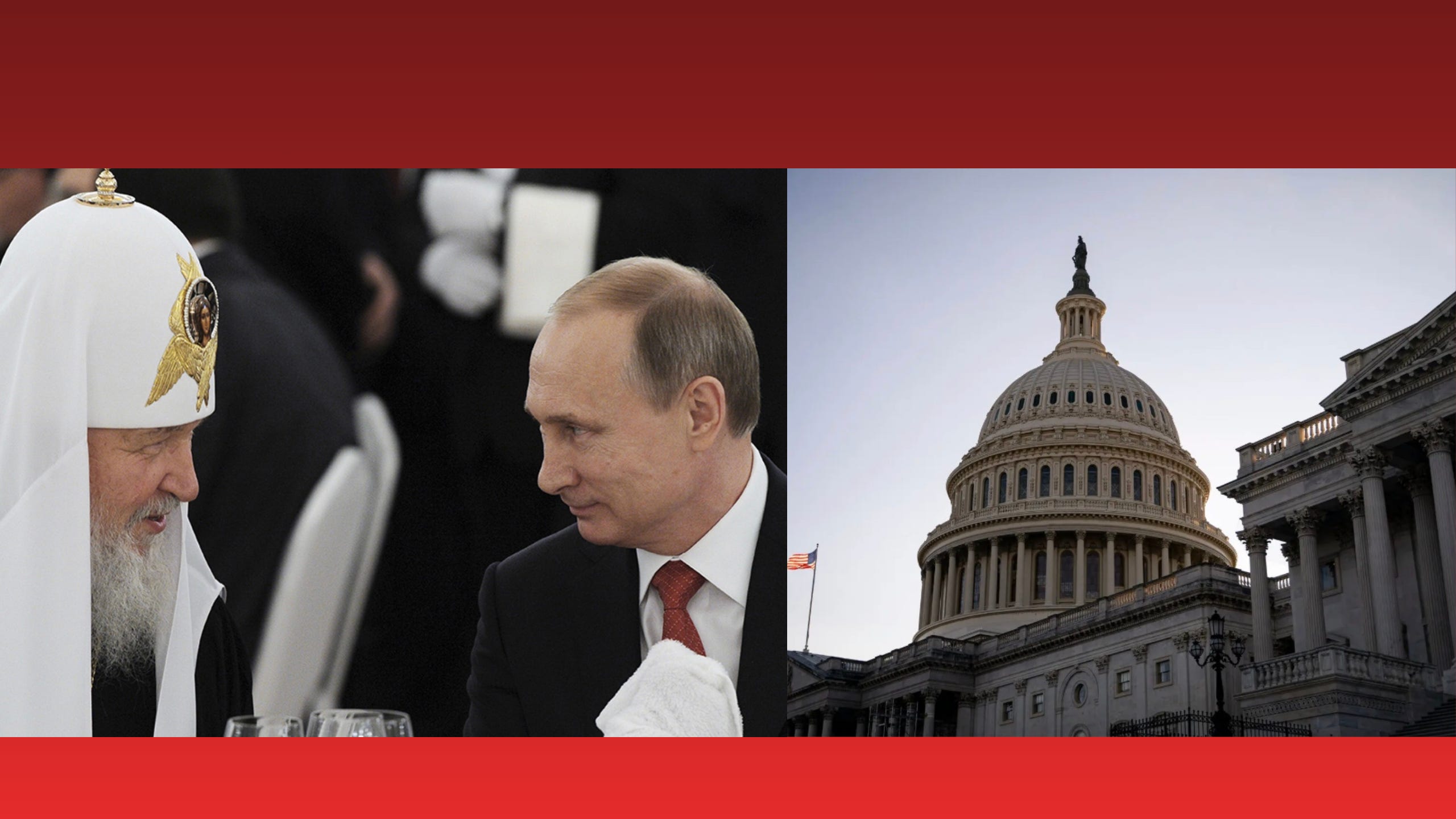
Olga Lautman & Andrii Luchkov: Russia’s Orthodox Influence Operation Hits Washington: How the “Christian Persecution” Disinformation Reached Congress
Executive Summary
A coordinated influence operation portraying Ukraine’s national security actions toward Moscow-linked Orthodox institutions as “religious persecution” reached the U.S. Congress in November and December 2025 through faith-branded advocacy and organized political access.
At the core of this operation is deception: Ukraine’s actions are falsely framed as a “ban on Orthodoxy,” when in fact they are national-security measures targeting a Moscow-subordinated institution tied to Russia’s genocidal war and intelligence apparatus—misleading Western audiences unfamiliar with Ukraine’s church structures into believing a fabricated narrative of religious repression.
The congressional outreach was publicly organized by U.S.-based Orthodox groups, ROCOR, and clergy linked to Russian Orthodox institutions and Russia-based organizations. The claims repeated disinformation Russia has promoted since around its 2014 invasion of Ukraine, and which Russian state media and senior officials re-launched in 2023 as a coordinated operation targeting Western governments and institutions.
Beginning in mid-2023, a Western law firm hired by the sanctioned Ukrainian oligarch Vadym Novinskyi played a central role in repackaging Russian state disinformation for Western audiences, via Amsterdam & Partners, and paid commentary that was disclosed under the Foreign Agents Registration Act.
Corporate records in Ukraine and Cyprus reveal that media outlets central to the campaign, including the Union of Orthodox Journalists (UOJ/SPZH), operated as commercial entities.
Corporate filings reveal overlapping management and control between UOJ-linked associates and companies associated with Kirill Dmitriev, the head of Russia’s state-owned Russian Direct Investment Fund (RDIF), a sanctioned Kremlin insider and Vladimir Putin’s moneyman.
As Ukrainian authorities increased scrutiny of Russian intelligence operations conducted through religious networks, multiple figures connected to UOJ and Moscow-aligned church advocacy relocated to Cyprus, a jurisdiction commonly used for asset protection and legal insulation.
Russian state and proxy media repeatedly cited U.S. political engagement, including meetings on Capitol Hill, as independent confirmation of claims that originated within Russia’s intelligence services.
The same “persecuted Christians” narrative is now being deployed beyond Ukraine, including in Armenia, where Amsterdam & Partners is also amplifying church-centered accusations as Russia prepares to interfere in upcoming elections.
Meanwhile in Russia & China…Putin has signed a law banning the enforcement of foreign criminal court rulings in Russia unless based on a UN Security Council resolution or an international treaty involving Russia. The move targets rulings like the ICC arrest warrant against him for war crimes in Ukraine and potential future tribunals over Russian aggression.
Reminder: In June, Ukraine and the Council of Europe human rights body signed an agreement which formed the basis for a special tribunal intended to bring to justice senior Russian officials for the crime of aggression against Ukraine.
Ukraine has demanded the creation of such a body since Russia’s full-scale invasion was launched in February 2022, accusing Russian soldiers of committing thousands of war crimes.
Steve Rosenberg for the BBC: How does Moscow view Donald Trump at the end of 2025? One Russian paper today: “The US leader’s philosophy is closer to the values of Russia’s president, not the politicians of the Old World…he sees Europe as a liberal stronghold that must be destroyed…”
The BBC—The Rich and the Voiceless: How Putin Keeps Russian Billionaires on His Side in the War
During the war with Ukraine, the number of billionaires in Russia reached a historic high. But after 25 years of Vladimir Putin in power, Russian tycoons and power players – known as oligarchs – have lost almost all of their political influence.
Western sanctions have not managed to turn the ultra-rich into his opponents, and the carrot-and-stick policy has made them silent supporters.
Elite Control and Economic Loyalty
The former banker-billonaire Oleg Tinkov understands well how the whip works in the ruling system. The day after he called the war “crazy” in a post, his top executives were contacted by the Kremlin. They were told that Tinkoff Bank – at that time the second largest in Russia – would be nationalized if all ties with its founder were not severed.
Following this pressure, another figure stepped in: a company linked to Vladimir Potanin – now the fifth-richest businessman in Russia, who supplies nickel for fighter jet engines – announced the purchase of the bank. According to Tinkov, it was sold for only 3% of its real value. As a result, Tinkov lost almost $9 billion of his former wealth and left Russia.
According to Forbes, in 2022 their number shrank from 117 to 83 due to the war, sanctions, and ruble depreciation. Collectively they lost $263 billion – an average of 27% of their wealth.
However the coming years showed that participation in Putin’s war economy can bring enormous benefits. The rapid growth in war spending pushed Russia’s economy by more than 4% in 2023 and 2024. In 2024, more than half of Russia’s billionaires participated in arming the army or benefited from the invasion, according to Giacomo Tonini of Forbes Wealth.
In 2024, Russia recorded a record number of billionaires – 140 according to Forbes. Their combined wealth was about $580 billion, only $3 billion less than the historical peak recorded before the invasion. (continue)
China Daily: "The use of the 'Justice Mission 2025' code name emphasizes the legitimacy and legality of our military actions. The drills aim to safeguard national sovereignty and territorial integrity, and to protect the safety and well-being of all Chinese people, including Taiwan compatriots," said Zhang Chi, a professor at the PLA National Defense University.
Mo: The following video was published by the PLA and re-posted with the message that the China would “Thwart Taiwan Independence”.
There was an increase in Chinese information operations over the past few weeks, which served to accompany Monday’s China’s live-fire military drills around Taiwan, simulating a blockade of major ports, attacking maritime targets, and fending off international “interference”, in what it calls a warning to “separatist” forces in Taiwan.
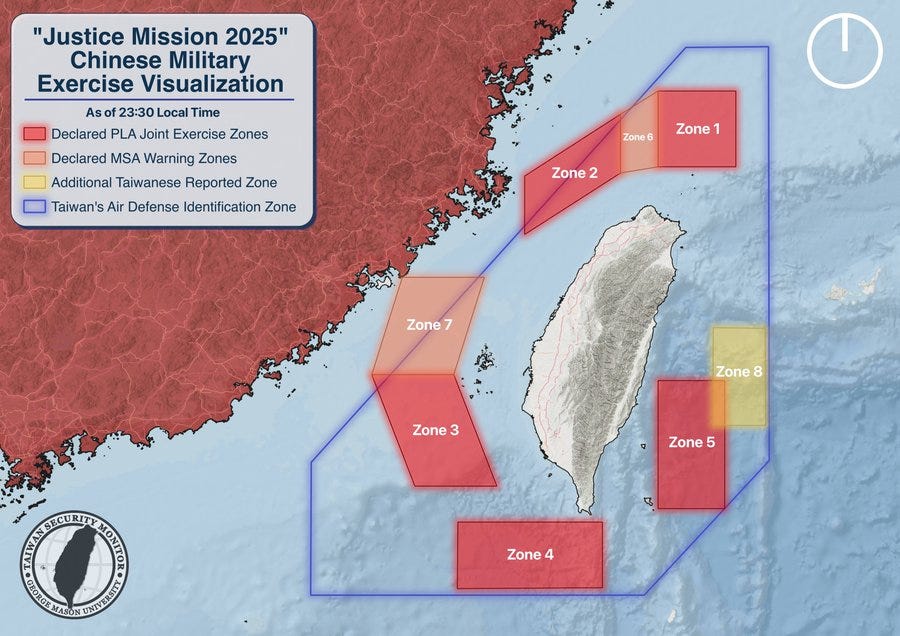
The People’s Liberation Army (PLA) – the military wing of the ruling Communist party in China – said it had sent naval, air force and rocket forces to surround Taiwan on Monday morning. Chinese coast guard vessels were also sent out to conduct “law enforcement inspections” at sea around Taiwan’s outer islands.
The exercise, named Justice Mission 2025, was a “a stern warning against ‘Taiwan independence’ separatist forces and external interference forces”, said a spokesperson for the PLA’s eastern theatre command, Col Shi Yi.
On Monday morning Taiwan’s defence ministry accused Beijing of escalating tensions and undermining regional peace. It “strongly condemned” the activity, saying it dispatched “appropriate forces” to respond and conduct counter combat-readiness exercises of its own.
“Defending democracy and freedom is no provocation, and the existence of the Republic of China [Taiwan’s formal name] is not an excuse for aggressors to disrupt the status quo,” the ministry said.
The Taiwan Ministry of National Defense has announced that Rapid Response Exercises are currently underway across the country, in response to snap-military drills surrounding the island by the Chinese People’s Liberation Army Eastern Theater Command, with a number of units - including air-defense, anti-ship missile, and naval forces - being placed on high alert in preparation for any potential hostile action by China against Taiwan.
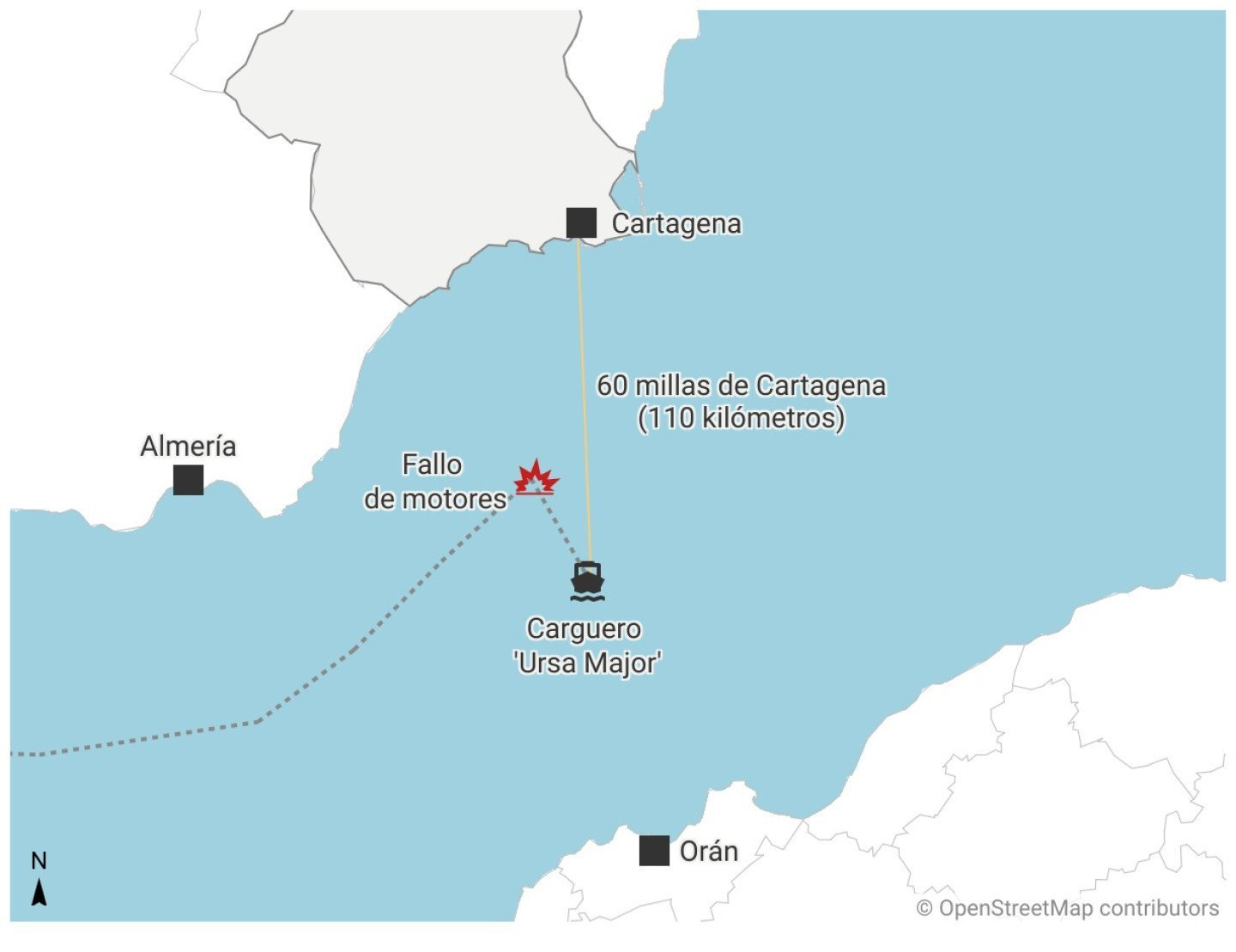
In Europe…Nuclear reactors to North Korea: Spanish investigators concluded that a sunken vessel from Russia’s "shadow fleet" was transporting two nuclear reactor vessels to North Korea. The ship Ursa Major sank on December 23, 2024, together with a "secret strategic cargo", approximately 60 nautical miles from Cartagena.
The Financial Times: Poland will force real estate developers to allocate space for bomb shelters in most new buildings from 2026, as the frontline state confronts the mammoth task of overhauling its lacklustre civilian defences against the threat of Russian aggression.
Support for Ukraine from Germany remains at a high level and is not being scaled back. This was stated at a briefing on December 29 in Berlin by representatives of several government ministries, without going into unnecessary details, but emphasising their full readiness to support the country within all necessary frameworks.
In particular, Susanne Ungrad, spokesperson for the German Federal Ministry for Economic Affairs, assured that aid remains in full. She explained that the decrease in figures regarding weapon exports from the start of 2025 is related to statistical peculiarities and the nature of the support provided.
Germany’s CSU has proposed barring the far-right AfD from the 2026 Munich Security Conference, citing security concerns. The AfD was also excluded in 2024 and 2025 for rejecting the conference’s principle of “peace through dialogue” and boycotting Zelensky’s Bundestag speech.
Latvia has delivered 34 vehicles and humanitarian aid to Ukraine, the Latvian MFA says. The convoy included 21 4×4 vehicles, ambulances for casualty evacuation, and transport from Latvia’s parliament. Since the start of the war, Latvia has sent 3,402 vehicles to Ukraine.
Pope Leo XIV has sent humanitarian aid to Ukraine, three trucks carrying 100,000 servings of instant soup for communities affected by the war. “The Pope not only prays for peace but also seeks to support suffering families,” a Vatican official said.
Il Sole 24Ore: Since the start of Russia’s full-scale invasion, Italy has provided Ukraine with weapons, military equipment and other resources totaling over €3 billion, General Luciano Portolano, Chief of the Italian Defence General Staff, said this in an interview with Il Sole 24 Ore.
According to him, the aid is being implemented under 11 interagency government decrees that authorize the supply of military materials, equipment, and other gear to Ukraine. The Italian Ministry of Defence continues bilateral support to Ukraine within the framework of these measures. The Italian government has not allocated disbursements and aid to Ukraine in the budget to be voted by the Italian parliament for FY2026. However, Portolano said that Italy is already discussing the adoption of the 12th decree, which would provide for further military aid to Ukraine.